Europe
Flag of Luxembourg
Luxembourg is a small landlocked grand duchy in Western Europe, bordered by Belgium, France, and Germany, and is one of the wealthiest countries in the world per capita. It hosts key European Union institutions and is a major centre for European banking and finance. Despite its tiny size, Luxembourg has three official languages — Luxembourgish, French, and German — reflecting its position at the crossroads of European cultures.

- CapitalLuxembourg City
- RegionEurope
- Current flag since1845
- Main coloursRed, White, Blue
- Populationabout 660,000
- Areaabout 2,600 km²
- GeographyLandlocked
- Flags in history2
Population and area are rounded.
What the flag of Luxembourg means
Red, white and blue come from the coat of arms of the House of Luxembourg, a red lion on blue and white stripes. The flag was only formally adopted by law in 1972. It looks almost the same as the Dutch flag, but is longer and uses a lighter blue. Over the years some politicians have proposed replacing it with the red lion flag, which remains popular with Luxembourgers.
More about the flag
Luxembourg's red, white and blue were in use from the 1830s, when the Grand Duchy began to separate from the Netherlands, but they only received legal status in 1972. The capital, also called Luxembourg, is one of the seats of the European Union, and the country is one of the six founding members of the European communities.
How to recognise it
Nearly identical to Netherlands but the bottom stripe is lighter (sky blue vs. navy).
Did you know?
Luxembourg has the highest GDP per capita in the world.
Easily confused with
Luxembourg's flag is often mixed up with these. Learn to tell them apart:
Flag history of Luxembourg
Every flag that has flown over Luxembourg, from today back through time.
1845–present
Red-white-blue tricolor
Fixed in 1845 and only legally formalized in 1993, Luxembourg's tricolor has been essentially unchanged for over 175 years. It is nearly identical to the Netherlands' flag but is longer and uses a lighter blue.
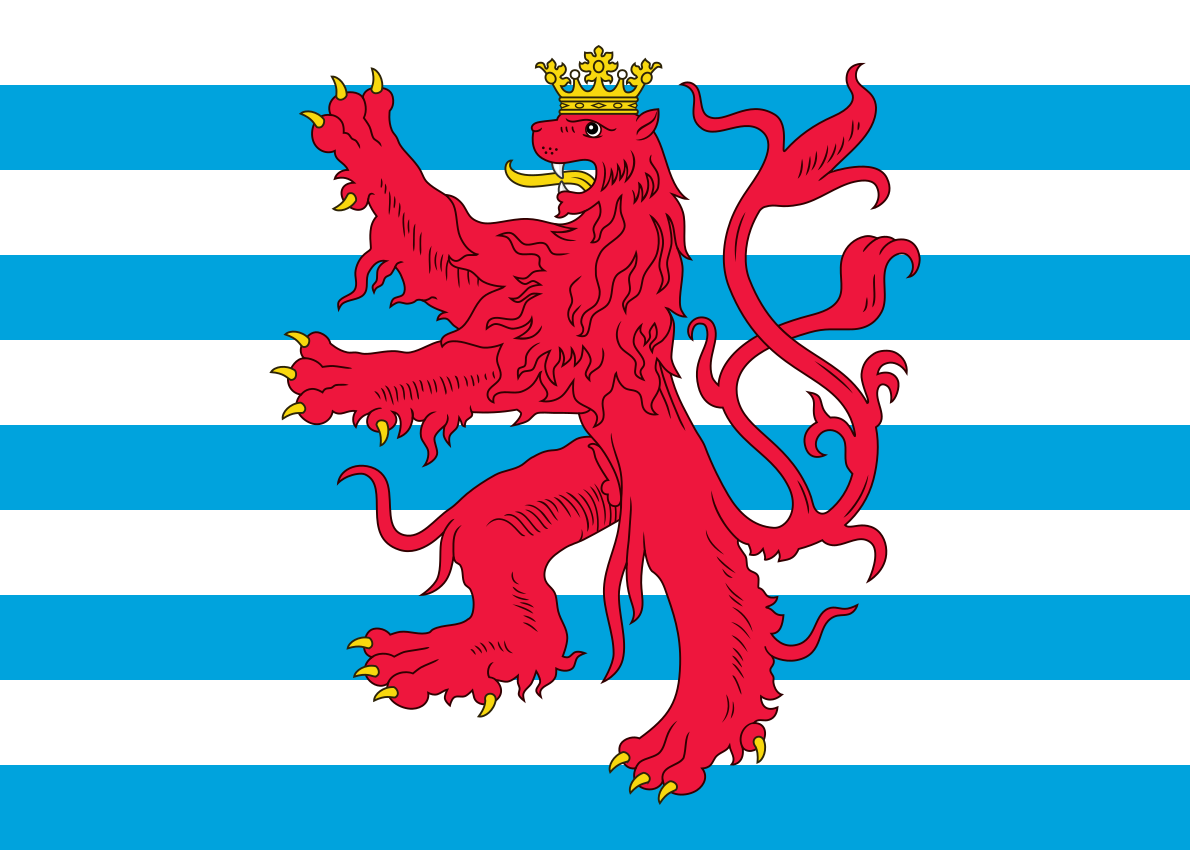
1100–1845
Roude Léiw (the Red Lion)
Long before the tricolor, Luxembourg's emblem was the "Roude Léiw" — a red, double-tailed, crowned lion on a field of white and blue stripes, the arms of the medieval Counts (later Dukes) of Luxembourg dating to the 13th century. It still flies today as the country's civil ensign and is cherished as the older, more distinctly Luxembourgish banner.
Neighbouring countries
Luxembourg shares a land border with 3 countries: Belgium, France and Germany.
Other flags in red, white and blue
30 other national flags use the same main colours as Luxembourg's.
Play Globalio and learn Luxembourg's flag
 Netherlands
 France
 Belgium
 Germany
 Australia
 Belize
 Cambodia
 Chile
 Costa Rica
 Croatia
 Cuba
 Czech Republic
 Dominican Republic
 Fiji
 Iceland
 Laos
 Liberia
 Nepal
 New Zealand
 North Korea
 Norway
 Panama
 Paraguay
 Russia
 Samoa
 Serbia
 Slovakia
 Slovenia
 Taiwan
 Thailand
 United Kingdom
 United States