
1993–present
Kingdom of Cambodia
The 1948 Angkor Wat design was readopted in 1993 when the monarchy was restored. Cambodia is one of only a few countries whose flag depicts a building — and it has done so under nearly every regime since 1948.
Cambodia is a Southeast Asian country home to Angkor Wat, the world's largest religious monument, a 12th-century Hindu temple complex later converted to Buddhism. The country suffered the devastating Khmer Rouge genocide from 1975 to 1979, during which an estimated 1.7 to 2.5 million people — roughly a quarter of the population — died from execution, starvation, disease, and forced labour. Cambodia has since rebuilt significantly and attracts millions of tourists to the magnificent temples of Angkor.
Population and area are rounded.
Cambodia's flag shows Angkor Wat, the 12th-century temple complex, in white to stand for religion and integrity, with blue for the monarchy and red for the nation. It is one of very few national flags to show a building. First adopted in 1948, it was replaced under the Khmer Rouge and the People's Republic and restored in 1993 with the return of the monarchy.
Horizontal blue-red-blue with an image of Angkor Wat in the centre.
Cambodia is home to Angkor Wat, the world's largest religious monument.
Every flag that has flown over Cambodia, from today back through time.
The 1948 Angkor Wat design was readopted in 1993 when the monarchy was restored. Cambodia is one of only a few countries whose flag depicts a building — and it has done so under nearly every regime since 1948.
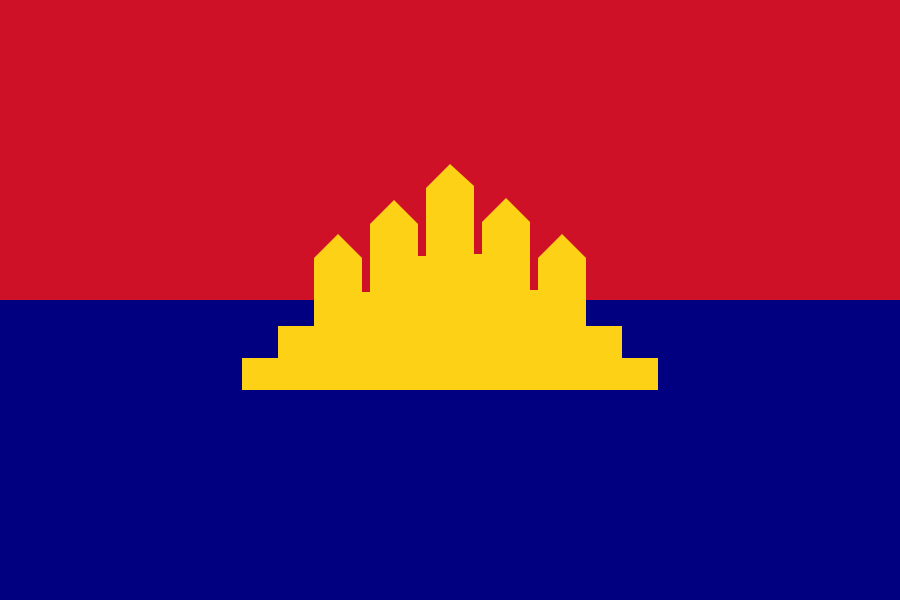
A horizontally divided red-over-blue flag, each band charged with a yellow Angkor Wat, used after the country renamed itself the State of Cambodia.
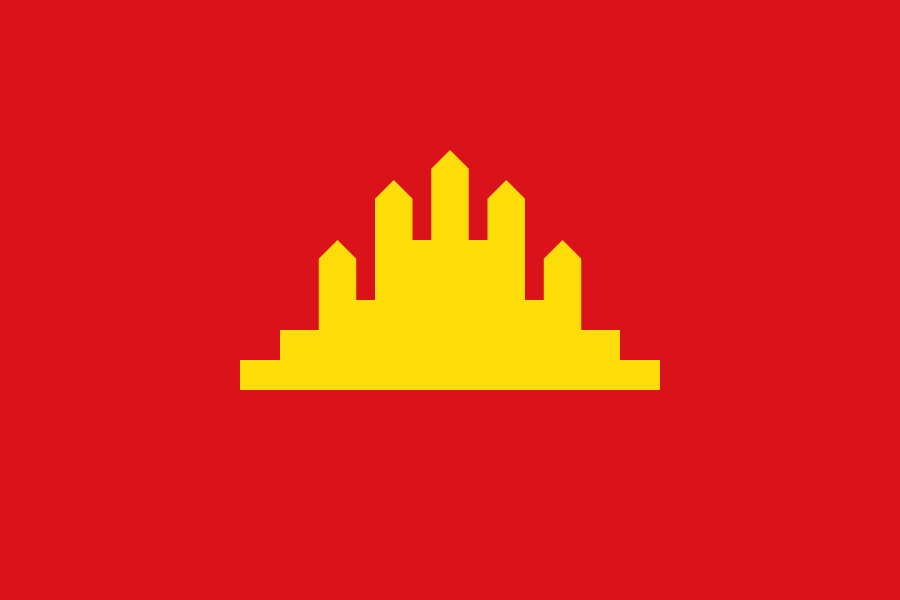
The Vietnamese-backed government's red flag with a yellow five-towered Angkor Wat — two more towers than the Khmer Rouge version it replaced.
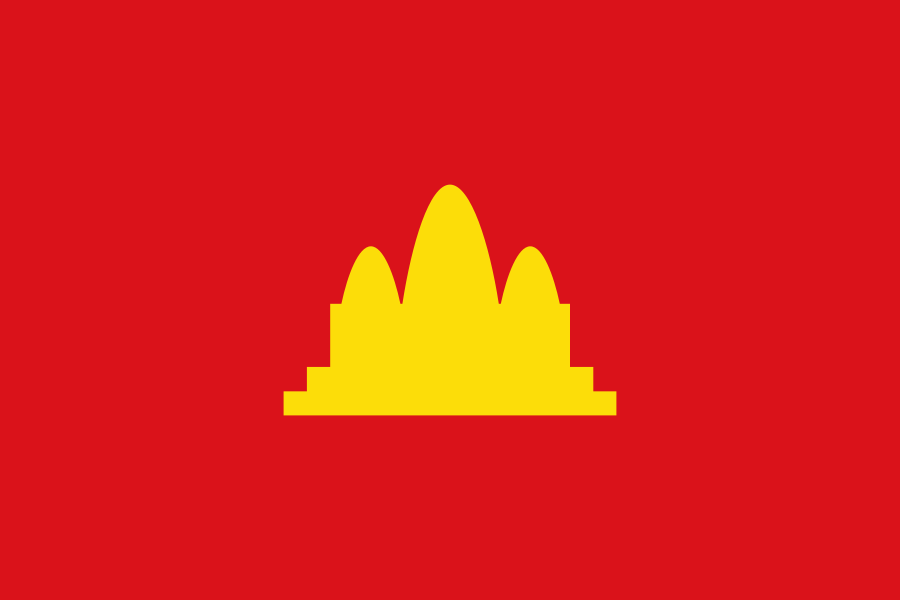
A plain red field with a stylized yellow three-towered Angkor Wat, flown during the genocidal Pol Pot regime.
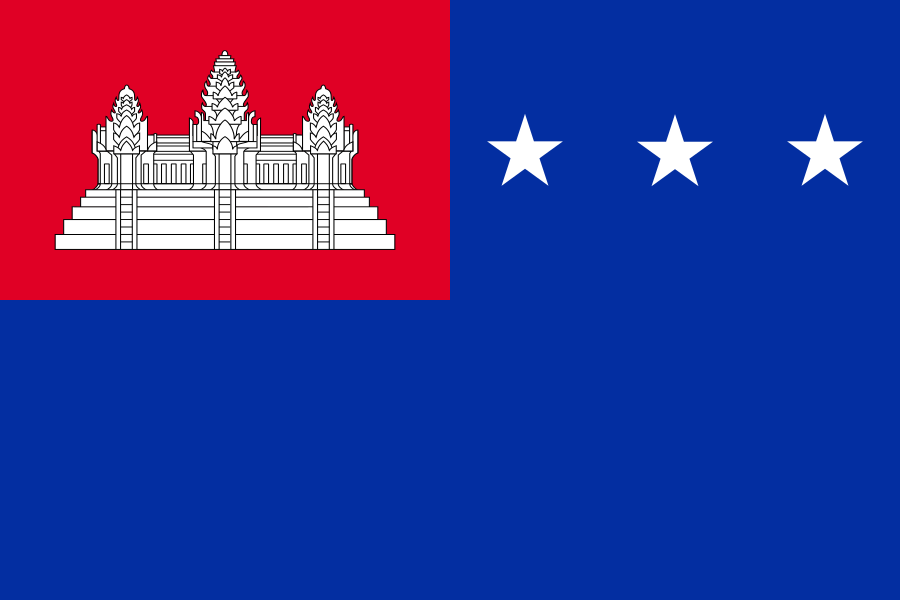
Lon Nol's republic kept Angkor Wat but moved it to a red canton with three white stars for the legislative, executive, and judicial branches.
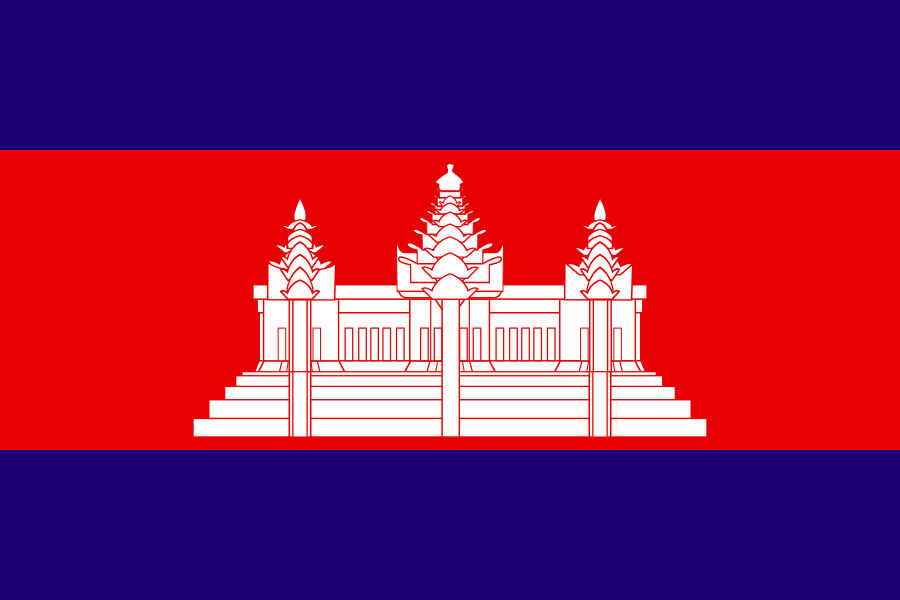
A blue-red-blue tricolour with a white Angkor Wat on the central band, adopted on independence from France — the original of the design used today.

Heir to the mighty Khmer Empire that built Angkor, Cambodia had shrunk and was being squeezed between Siam and Vietnam when it accepted a French protectorate in 1863 — flying the French flag as part of French Indochina until independence in 1953. French rule almost certainly saved Cambodia from being partitioned out of existence by its neighbours.
Empires, kingdoms and republics that once covered part of Cambodia.
Lon Nol's republic replaced the royal flag; its three white stars stand for the nation, religion, and republic. Angkor Wat has appeared on every Cambodian flag since the 1800s.
The Khmer Rouge state flew a red flag with a yellow three-towered Angkor Wat; its brutal four-year rule under Pol Pot killed an estimated quarter of Cambodia's population.
Cambodia shares a land border with 3 countries: Laos, Thailand and Vietnam.
30 other national flags use the same main colours as Cambodia's.
 Australia
 Belize
 Chile
 Costa Rica
 Croatia
 Cuba
 Czech Republic
 Dominican Republic
 Fiji
France
 Iceland
 Laos
 Liberia
 Luxembourg
 Nepal
 Netherlands
 New Zealand
 North Korea
 Norway
 Panama
 Paraguay
 Russia
 Samoa
 Serbia
 Slovakia
 Slovenia
 Taiwan
 Thailand
 United Kingdom
 United States
 Vietnam