
1975–present
Flag of Cameroon
Adopted in 1975 when Cameroon became a unitary state, merging the two earlier stars into a single central gold star symbolizing national unity.
Cameroon is located at the junction of West and Central Africa and is often called 'Africa in miniature' for its extraordinary geographical and cultural diversity, encompassing Atlantic beaches, volcanic mountains, savanna grasslands, tropical rainforests, and the Saharan fringes. The country has over 250 ethnic groups and was formerly divided between British and French colonial administration. Yaoundé is the political capital while Douala is the main port city and economic hub.
Population and area are rounded.
Cameroon uses the Pan-African colours: green for the forests of the south, yellow for the savannas of the north, and red for unity. The yellow “star of unity” was adopted in 1975; from 1961 two stars had stood for the two federated states of formerly French and British Cameroon. The original flag of 1957 had no stars at all.
Cameroon was a German colony until the First World War, after which it was divided between France and Britain. French Cameroon became independent in 1960, and in 1961 the southern part of British Cameroons voted to join it, while the north joined Nigeria; that union is why the flag carried two stars until 1975. Cameroon's football team, the Indomitable Lions, carries the flag's colours.
Vertical green-red-yellow with a single yellow star in the red centre.
Cameroon is often called "Africa in miniature" because it contains nearly every major climate zone found in Africa.
Cameroon's flag is often mixed up with these. Learn to tell them apart:
Every flag that has flown over Cameroon, from today back through time.
Adopted in 1975 when Cameroon became a unitary state, merging the two earlier stars into a single central gold star symbolizing national unity.
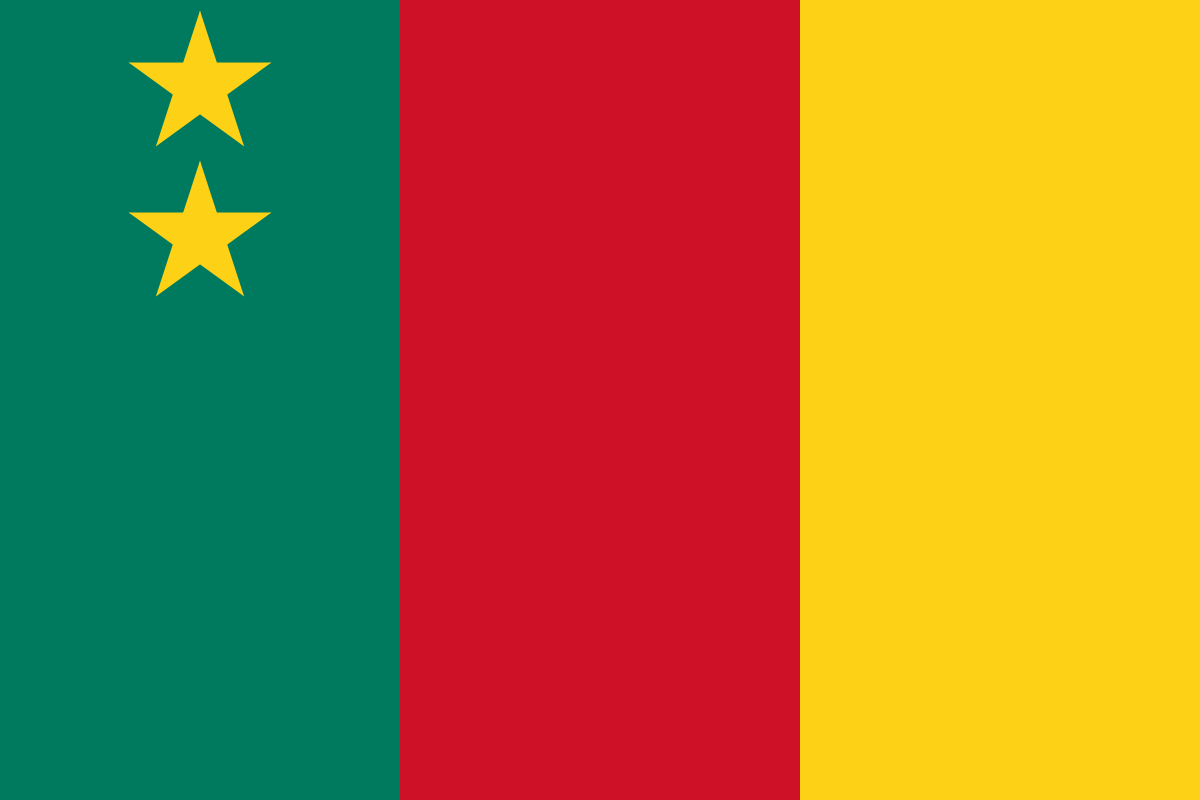
After the 1961 federation, two gold stars were added to the green band representing the two states — East (French) and West (British) Cameroon.
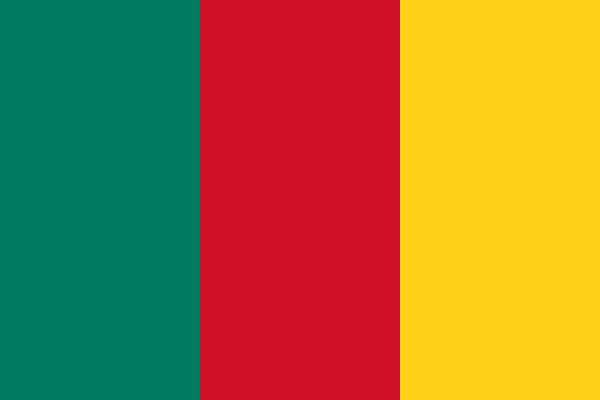
Made law in 1957 and carried into independence in 1960, among the first pan-African-colored flags adopted by a sub-Saharan state.
Cameroon shares a land border with 6 countries: the Central African Republic, Chad, Equatorial Guinea, Gabon, Nigeria and the Republic of the Congo.
11 other national flags use the same main colours as Cameroon's.
 Benin
 Bolivia
 Burkina Faso
 Grenada
 Guinea
 Lithuania
 Mali
 Mauritania
 Portugal
 Republic of the Congo
 Senegal
 Central African Republic
 Chad
 Equatorial Guinea
 Gabon
 Nigeria