 Algeria
 Saudi Arabia

2017–present
Flag of Mauritania
A 2017 referendum added horizontal red bands top and bottom to honor the blood shed by Mauritanians in the struggle for independence.
Mauritania is a large country in northwestern Africa, serving as a cultural and geographical bridge between the Arab Maghreb of North Africa and sub-Saharan West Africa. The Sahara Desert covers most of its territory, with most of the population concentrated in the south. Mauritania was the last country in the world to officially abolish slavery, doing so in 1981, though enforcement continues to be a challenge.
Population and area are rounded.
The green field and the gold crescent and star are symbols of Islam, and gold also stands for the sands of the Sahara. The two red stripes were added after a 2017 referendum to honour the blood shed by those who fought for independence from France. The original green flag was adopted in 1959, the year before independence.
The 2017 referendum that added the red stripes also abolished Mauritania's Senate; opposition parties boycotted the vote. Mauritania lies where the Arab Maghreb meets sub-Saharan Africa, and most of it is Sahara desert. Its capital, Nouakchott, grew from a small village into the main city after it was chosen as capital at independence in 1960.
Green with a yellow crescent and star, and horizontal red stripes top and bottom.
Mauritania was the last country in the world to officially abolish slavery, in 1981 (criminalized in 2007).
Mauritania's flag is often mixed up with these. Learn to tell them apart:
Every flag that has flown over Mauritania, from today back through time.
A 2017 referendum added horizontal red bands top and bottom to honor the blood shed by Mauritanians in the struggle for independence.
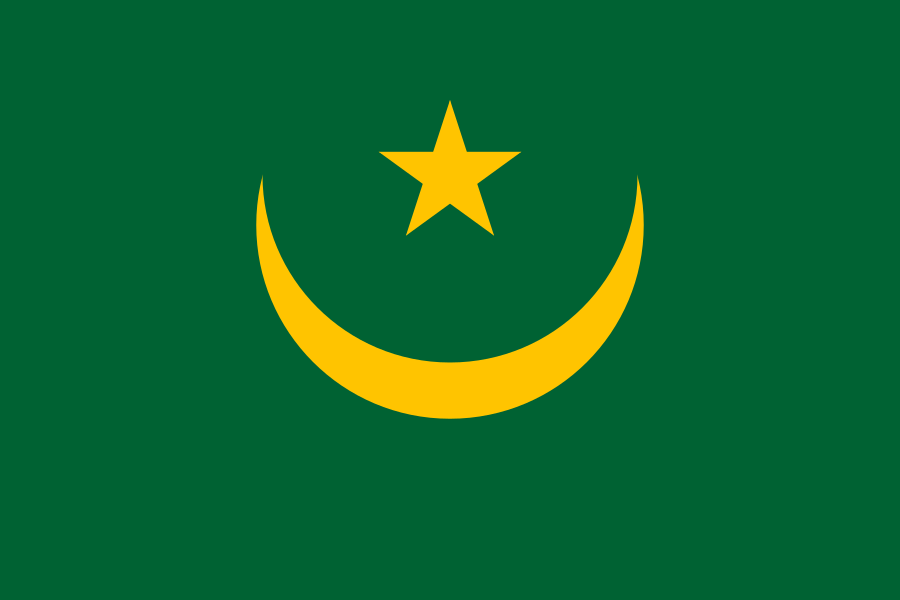
Adopted in 1959 ahead of independence from France: a plain green field with a gold crescent and star, both colors and symbols of Islam.
Mauritania shares a land border with 3 countries: Algeria, Mali and Senegal.
11 other national flags use the same main colours as Mauritania's.
 Benin
 Bolivia
 Burkina Faso
 Cameroon
 Grenada
 Guinea
 Lithuania
 Mali
 Portugal
 Republic of the Congo
 Senegal