 Cameroon
 Burundi

1979–present
Flag of Equatorial Guinea (restored)
The original 1968 design with the silk-cotton-tree coat of arms was restored in 1979 after dictator Macías Nguema was deposed, and remains in use.
Equatorial Guinea is the only Spanish-speaking country in Africa, a distinction reflecting its colonial history as a Spanish territory. It consists of a mainland region called Río Muni and several islands including Bioko, where the capital Malabo is located. The discovery of significant offshore oil deposits in the 1990s dramatically increased national income, though wealth distribution remains highly unequal among the population.
Population and area are rounded.
Green represents the natural resources and forests, white peace, red the fight for independence, and the blue triangle the sea that links the mainland with the islands. The coat of arms shows a silk-cotton tree and six stars for the mainland and the five main islands, with the motto “Unidad, Paz, Justicia”. The flag was adopted at independence from Spain in 1968.
Equatorial Guinea became independent from Spain on 12 October 1968. Under the dictatorship of Francisco Macías Nguema in the 1970s the coat of arms was replaced with one showing a rooster and work tools; the original arms returned after his overthrow in 1979. The six stars stand for the mainland, Río Muni, and the islands of Bioko, Annobón, Corisco, Elobey Grande and Elobey Chico. It is the only African country with Spanish as an official language.
Horizontal green-white-red with a blue triangle at the hoist and a silk-cotton tree coat of arms.
Equatorial Guinea is the only Spanish-speaking country in sub-Saharan Africa.
Equatorial Guinea's flag is often mixed up with these. Learn to tell them apart:
Every flag that has flown over Equatorial Guinea, from today back through time.
The original 1968 design with the silk-cotton-tree coat of arms was restored in 1979 after dictator Macías Nguema was deposed, and remains in use.
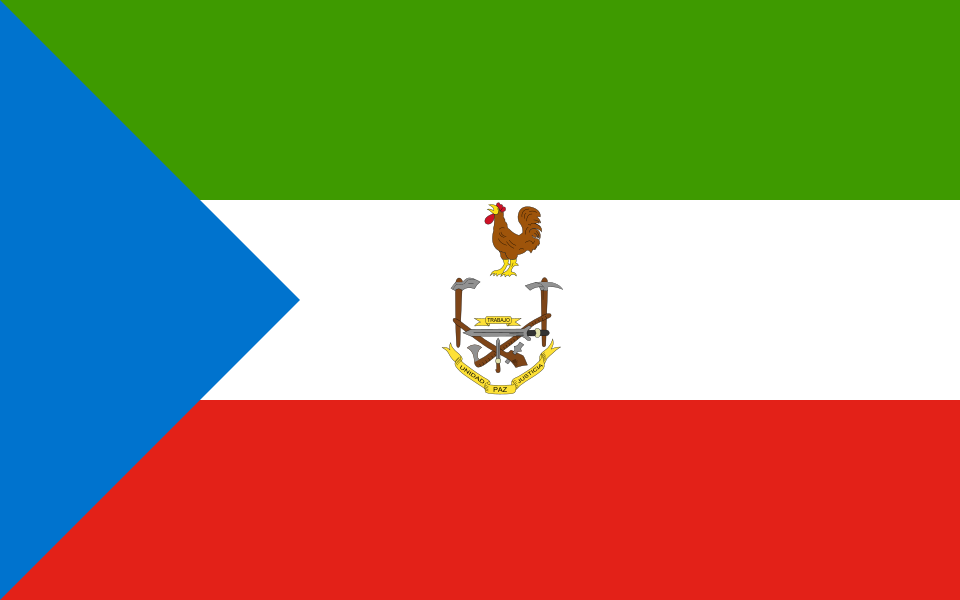
Under dictator Francisco Macías Nguema the central emblem was replaced with a coat of arms of tools, a sword, and a cockerel, with the motto "Unidad, Paz, Justicia."
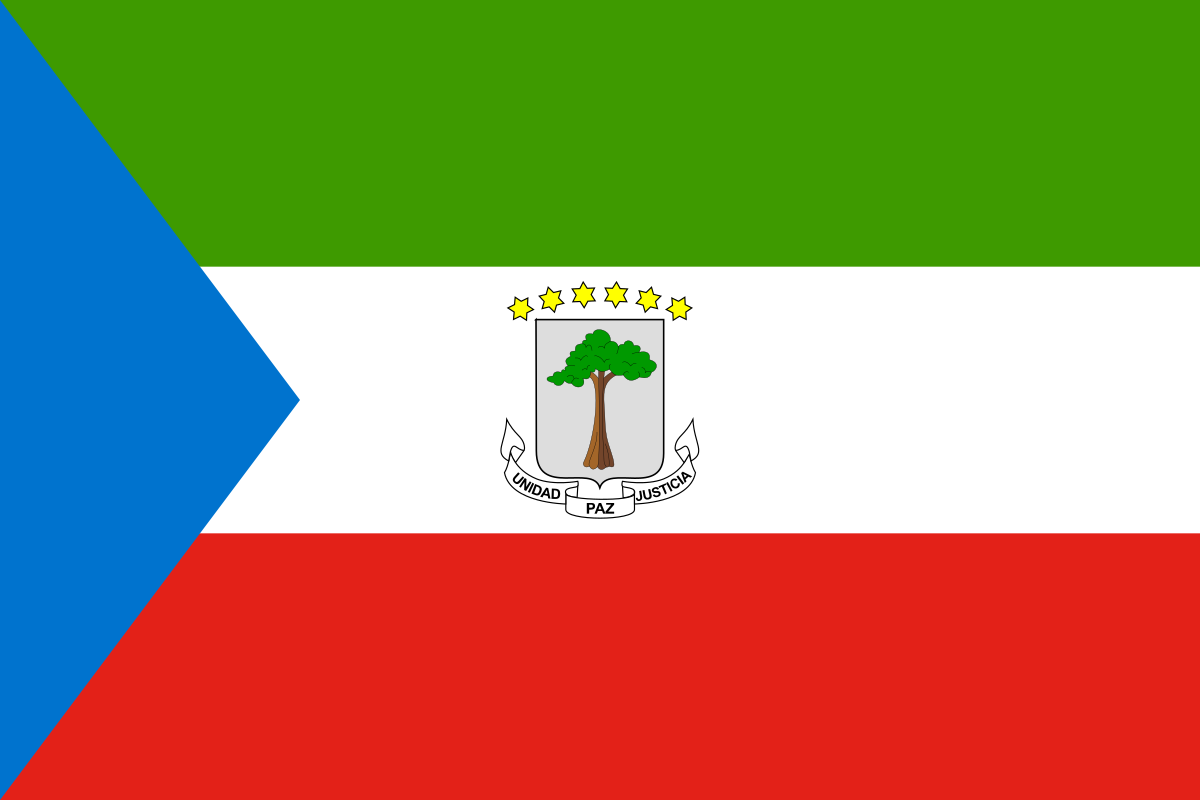
Adopted at independence from Spain in 1968: green, white, and red bands with a blue hoist triangle and the silk-cotton-tree coat of arms at the center.
Equatorial Guinea shares a land border with 2 countries: Cameroon and Gabon.
4 other national flags use the same main colours as Equatorial Guinea's.
Play Globalio and learn Equatorial Guinea's flag Gabon
 Azerbaijan
 Djibouti
 Gambia
 Uzbekistan