
1958–present
Flag of Guinea
Adopted in 1958 after Guinea alone rejected the French Community and chose immediate independence under Sékou Touré. The red-yellow-green tricolour mirrors Ghana's pan-African colors and has never changed.
Guinea is a West African nation on the Atlantic coast, sometimes called Guinea-Conakry to distinguish it from Guinea-Bissau and Equatorial Guinea. It is one of the world's largest producers of bauxite, the ore from which aluminium is refined, and has significant iron ore, gold, and diamond deposits. Despite this mineral wealth, Guinea is one of the world's least developed countries, with most of its population depending on agriculture.
Population and area are rounded.
Red represents the blood of the martyrs and labour, yellow the sun and the country's gold, and green its vegetation, reflecting the national motto “Work, Justice, Solidarity”. The flag was adopted in 1958, when Guinea became the first French colony in Africa to vote for immediate independence.
Guinea was the only French colony in Africa to vote no in the 1958 referendum on joining the French Community, and it became independent on 2 October 1958 under Ahmed Sékou Touré. Its colours follow Ghana's Pan-African tricolour, as both countries hoped to form a union. Guinea holds some of the world's largest reserves of bauxite, the ore used to make aluminium.
Vertical red-yellow-green — the same colours as Mali but in reverse order.
Guinea holds the world's largest reserves of bauxite, the ore used to make aluminium.
Guinea's flag is often mixed up with these. Learn to tell them apart:
Every flag that has flown over Guinea, from today back through time.
Adopted in 1958 after Guinea alone rejected the French Community and chose immediate independence under Sékou Touré. The red-yellow-green tricolour mirrors Ghana's pan-African colors and has never changed.

A colony within French West Africa, French Guinea flew the French tricolor. In the 1958 referendum it became the only territory to vote "Non" to de Gaulle's French Community and chose immediate independence — to which an enraged France responded by stripping the country of everything it could, even ripping out telephone wires as it withdrew.
Empires, kingdoms and republics that once covered part of Guinea.
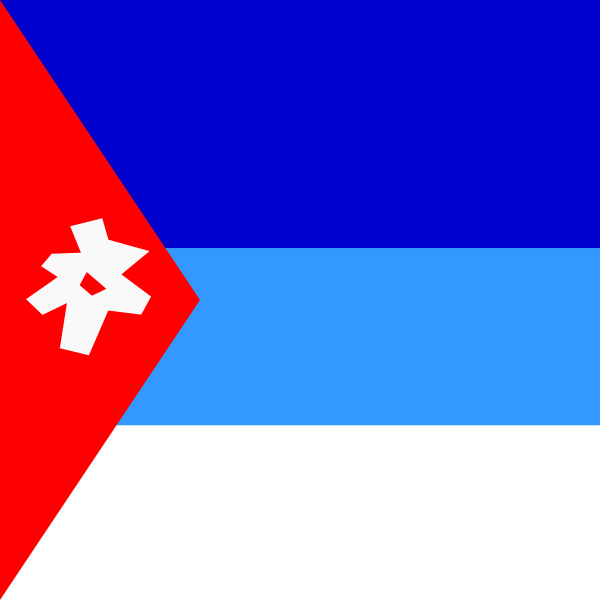
The West African empire built by Samori Ture, a brilliant military strategist who resisted French conquest for nearly two decades before his capture, flying a blue-white-red horizontal triband.
Guinea shares a land border with 6 countries: Côte d'Ivoire, Guinea-Bissau, Liberia, Mali, Senegal and Sierra Leone.
11 other national flags use the same main colours as Guinea's.
 Benin
 Bolivia
 Burkina Faso
 Cameroon
 Grenada
 Lithuania
 Mali
 Mauritania
 Portugal
 Republic of the Congo
 Senegal
 Côte d'Ivoire
 Guinea-Bissau
 Liberia
 Sierra Leone