 Guinea
 Cameroon

1991–present
Flag of the Republic of the Congo
With the collapse of the one-party Marxist state in 1991, the country readopted its original 1959 diagonal green-yellow-red tricolour in the pan-African colors.
The Republic of the Congo, sometimes called Congo-Brazzaville, is a Central African country along the Congo River, distinct from the much larger Democratic Republic of the Congo across the water. It gained independence from France in 1960 and has significant offshore oil reserves. Its capital Brazzaville sits directly across the Congo River from Kinshasa, making them the world's closest pair of capital cities, visible to each other across the water.
Population and area are rounded.
Green stands for the forests and hope, yellow for friendship and the nobility of the people, and red for the struggle for independence. The diagonal tricolour was adopted in 1959. From 1970 to 1991 the People's Republic of the Congo used a red flag with communist symbols, and the original flag was restored in 1991.
The Republic of the Congo, often called Congo-Brazzaville after its capital, became independent from France on 15 August 1960. It is a different country from its much larger neighbour, the Democratic Republic of the Congo: their capitals, Brazzaville and Kinshasa, face each other across the Congo River. The diagonal design is unusual among former French colonies, most of which chose vertical tricolours.
Diagonal green-yellow-red stripes from lower left to upper right.
The Republic of the Congo has one of the highest urbanisation rates in sub-Saharan Africa.
The Republic of the Congo's flag is often mixed up with these. Learn to tell them apart:
Every flag that has flown over the Republic of the Congo, from today back through time.
With the collapse of the one-party Marxist state in 1991, the country readopted its original 1959 diagonal green-yellow-red tricolour in the pan-African colors.
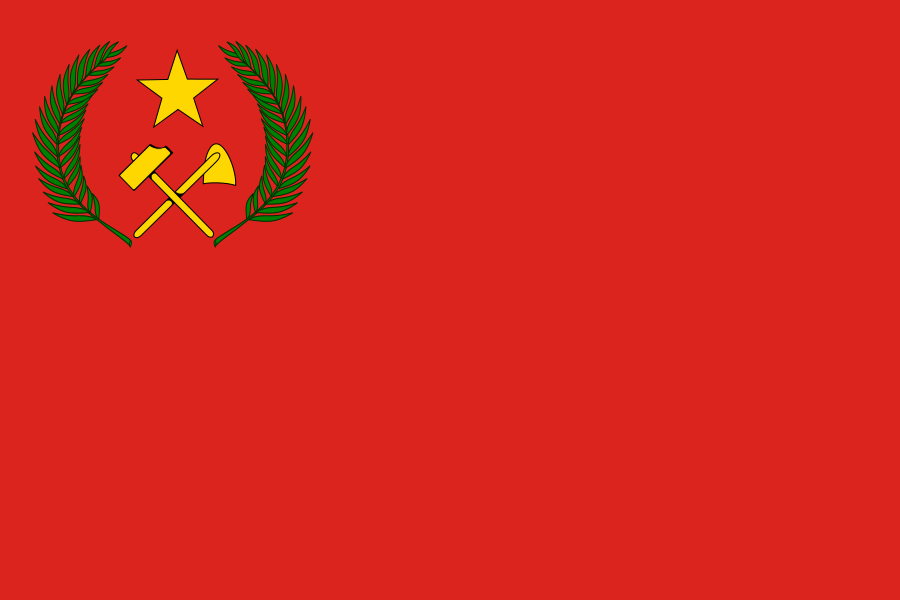
Under the Marxist-Leninist People's Republic of the Congo, a red field bore a crossed hoe and hammer within a star and palm wreath — one of Africa's few openly communist state flags.
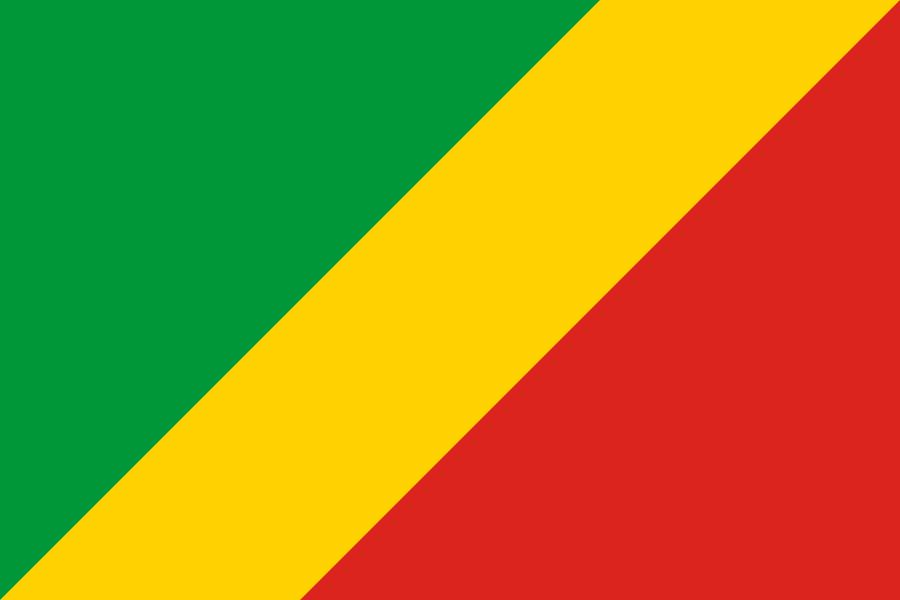
Adopted in 1959 before full independence, this green-yellow-red diagonal tricolour was abolished when the Marxist regime took power — then restored unchanged in 1991.
A coastal Kongo-related kingdom north of the Congo River, a major exporter of copper, ivory and enslaved people.
Empires, kingdoms and republics that once covered part of the Republic of the Congo.
A coastal trading kingdom north of the Congo River, famed for its cloth and ivory, before it fell under French control.
Congo-Brazzaville's Marxist–Leninist state flew a red flag with a crossed hoe and hammer beneath a star — the only avowedly communist state in Africa for much of the Cold War.
The Republic of the Congo shares a land border with 5 countries: Angola, Cameroon, the Central African Republic, the DR Congo and Gabon.
11 other national flags use the same main colours as the Republic of the Congo's.
Play Globalio and learn the Republic of the Congo's flag Angola
 Central African Republic
 DR Congo
 Gabon
 Benin
 Bolivia
 Burkina Faso
 Grenada
 Lithuania
 Mali
 Mauritania
 Portugal
 Senegal