Middle East
Flag of Iran
Iran, historically known as Persia, is home to one of the world's oldest continuous civilisations with a history spanning more than 5,000 years, including some of antiquity's greatest empires such as the Achaemenid Empire under Cyrus the Great. It is the world's largest Shia Muslim-majority country and has 27 UNESCO World Heritage Sites including Persepolis, the ceremonial capital of the ancient Persian Empire. Iran holds the world's second-largest natural gas reserves and fourth-largest oil reserves.

- CapitalTehran
- RegionMiddle East
- Current flag since1980
- Main coloursGreen, White, Red
- Populationabout 89 million
- Areaabout 1,648,000 km²
- Flags in history4
Population and area are rounded.
What the flag of Iran means
Green represents growth and Islam, white freedom and peace, and red martyrdom and courage. The red emblem, adopted after the 1979 revolution, is a stylised form of the word Allah that also looks like a tulip, a traditional symbol of martyrs. “Allahu Akbar” is written 22 times along the edges of the stripes, for the date of the revolution's victory, 22 Bahman in the Iranian calendar.
How to recognise it
Horizontal green-white-red with the Allah emblem and "Allahu Akbar" inscribed on the borders.
Did you know?
Iran (Persia) is home to one of the world's oldest civilisations, dating back over 7,000 years.
Easily confused with
Iran's flag is often mixed up with these. Learn to tell them apart:
Flag history of Iran
Every flag that has flown over Iran, from today back through time.
1980–present
Islamic Republic of Iran
Adopted after the 1979 Islamic Revolution, this flag keeps the green-white-red tricolor (unchanged since the Qajar era) but replaces the imperial lion and sun with the emblem of the Islamic Republic — a stylised Allah in the shape of a tulip, symbolising martyrdom. Along the borders of the green and red bands, the phrase "Allahu Akbar" (God is Greatest) is repeated 22 times, commemorating the 22nd of Bahman (February 11, 1979), the day of the revolution's victory.
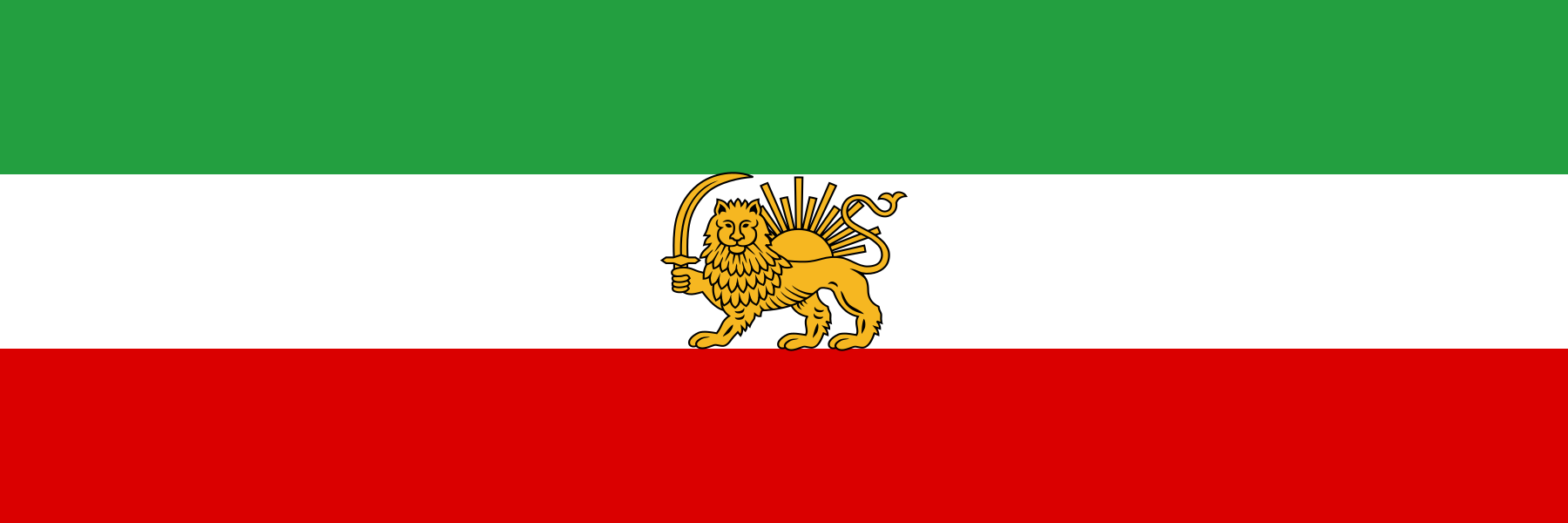
1925–1979
Imperial Standard (Pahlavi era)
The Pahlavi dynasty retained the ancient lion-and-sun emblem on the green-white-red tricolor: a lion holding a sword with a radiant sun rising behind it. This symbol of Persian royalty dated back to at least the 12th century. The 1979 revolution deliberately erased it — books and buildings bearing the lion and sun were defaced, making surviving examples historically significant.
Soviet-backed breakaway of 1946:
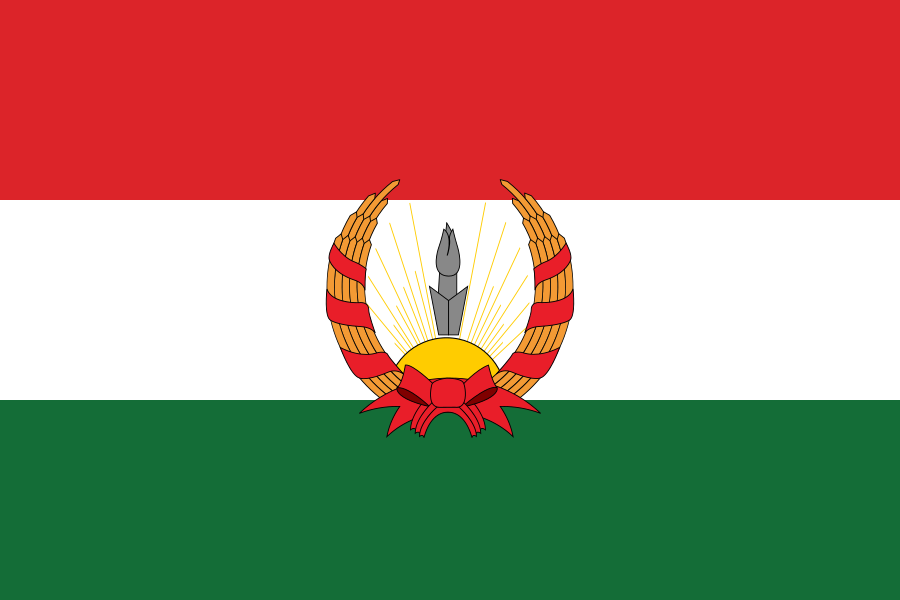
1946
Republic of Mahabad
A short-lived Kurdish state in northwestern Iran, set up with Soviet backing in January 1946 and collapsing that December once Soviet forces withdrew. It remains a foundational symbol of modern Kurdish nationalism.
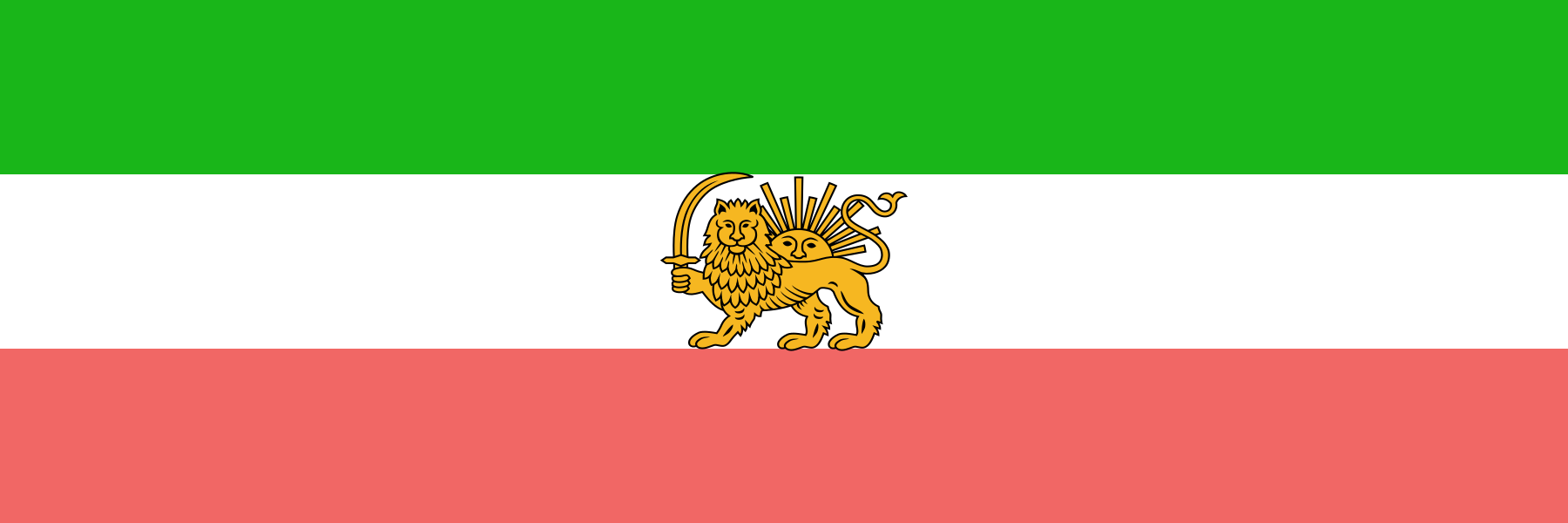
1907–1925
Constitutional Era
The Constitutional Revolution of 1906 forced the Qajar shahs to accept a parliament and a constitution — and updated the flag with the emblem centered on the white stripe for the first time. The lion-and-sun device in this form dated from at least the Safavid empire of the 16th century and symbolised the power of the Persian monarchy and state.
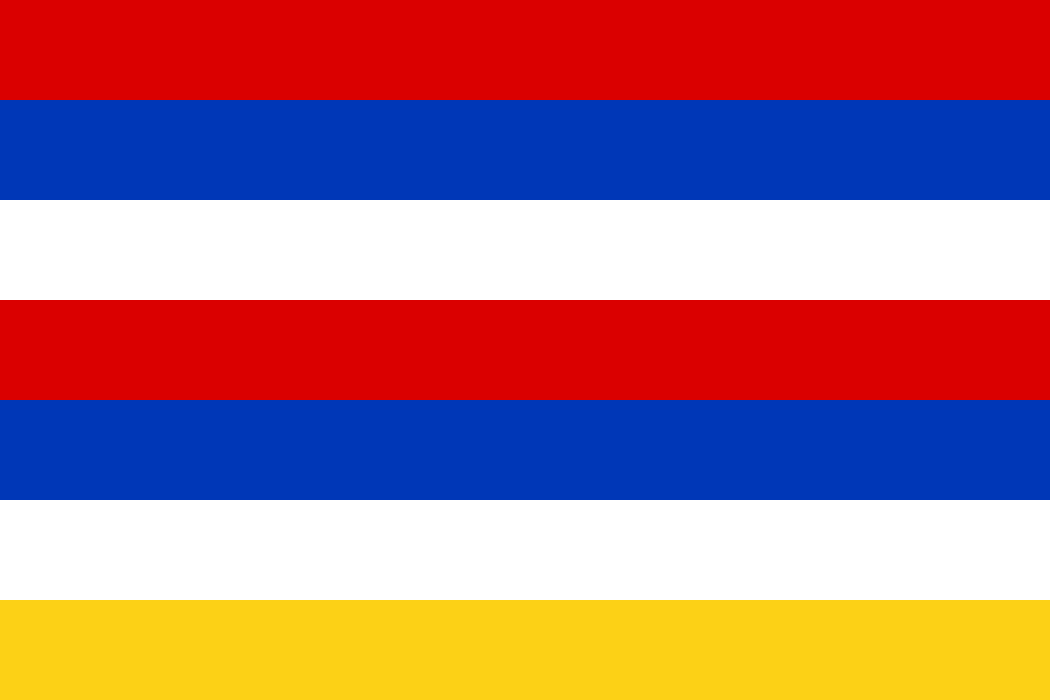
1501–1907
Safavid / Qajar Persia
The ancient Persian lion-and-sun motif predates any standardised tricolor. Under the Safavids and Qajars, the lion and sun appeared on battle standards, seals, and eventually on a green field. The familiar green-white-red arrangement was formalised only in the 19th century under the Qajars, but the lion and sun had represented Persian sovereignty for centuries before that.
Related historical states
Empires, kingdoms and republics that once covered part of Iran.
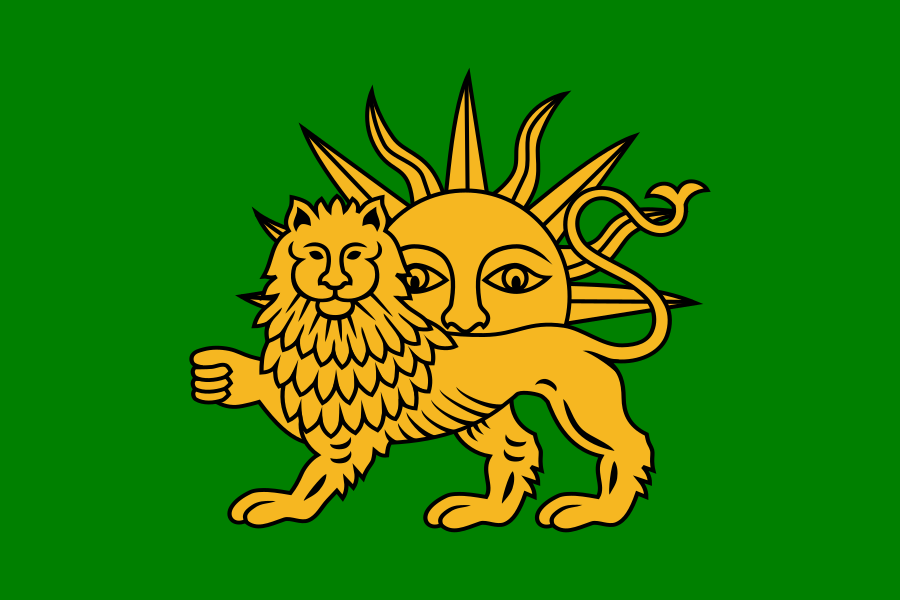
1501–1736
Safavid Empire
The Persian empire that made Twelver Shia Islam the state religion flew a green banner bearing a golden lion and sun, the Lion and Sun motif that would symbolize Iran for centuries.
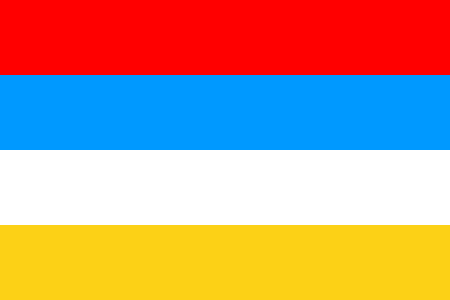
1736–1796
Afsharid Dynasty
The empire of the conqueror Nader Shah, who sacked Delhi and seized the Peacock Throne; his imperial standard carried the lion and sun on a red and yellow field.
1846–1925
Qajar Persia
The Lion and Sun on a tricolor of green, white, and red became Persia's flag under the Qajar shahs and endured through the empire until the 1979 revolution removed the emblem.
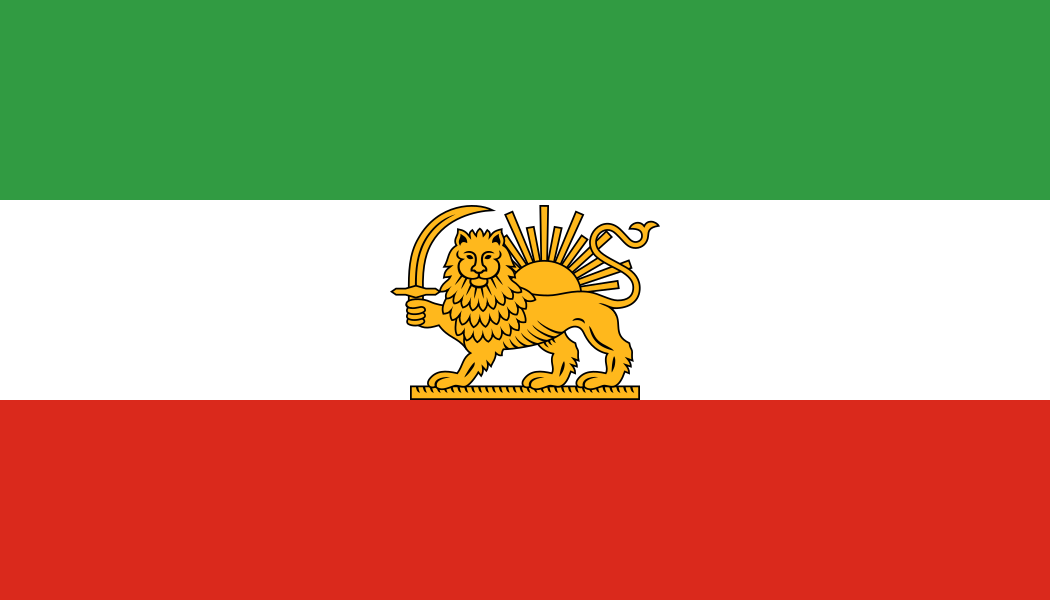
1964–1979
Imperial State of Iran (Pahlavi)
Under the Pahlavi shahs the green-white-red flag bore a crowned Lion and Sun; the crowned emblem was stripped away after the 1979 Islamic Revolution overthrew the monarchy.
Neighbouring countries
Iran shares a land border with 7 countries: Afghanistan, Armenia, Azerbaijan, Iraq, Pakistan, Turkey and Turkmenistan.
Other flags in green, white and red
12 other national flags use the same main colours as Iran's.
Play Globalio and learn Iran's flag
 Hungary
 Bulgaria
 Italy
 Afghanistan
 Armenia
 Azerbaijan
 Iraq
 Pakistan
 Turkey
 Turkmenistan
 Algeria
 Belarus
 Burundi
 Lebanon
 Madagascar
 Maldives
 Mexico
 Oman