 Senegal
 Slovenia

1982–present
Flag of Burundi
The current flag refined the proportions of the 1967 design: a white saltire dividing red and green fields, with three red stars on a central white disc for the motto "Unité, Travail, Progrès".
Burundi is one of the world's smallest and most densely populated countries, a landlocked nation in the Great Rift Valley of Central Africa. It shares significant ethnic, linguistic, and cultural ties with Rwanda to the north. Despite having fertile agricultural land and a beautiful landscape of hills and lakes overlooking Lake Tanganyika, Burundi is consistently ranked among the world's least developed nations.
Population and area are rounded.
The white saltire and centre stand for peace, green for hope and red for the struggle for independence. The three six-pointed stars represent the country's three main ethnic groups, the Hutu, Tutsi and Twa, and also the national motto “Unity, Work, Progress”. The flag was adopted in 1967, after the monarchy was abolished.
Burundi's first flag after independence from Belgium in 1962 also showed a drum, the symbol of the monarchy, and a sorghum plant in the central disc. When the monarchy was overthrown in 1966 they were removed, and the stars took their place. The flag's white saltire is unusual in Africa. The government moved the political capital from Bujumbura to Gitega in 2019.
Red-white-green divided diagonally by a white saltire, with three red-bordered green stars in the white centre.
Burundi is one of the few countries in the world that still performs the ancient Royal Drum ceremony, a UNESCO heritage.
Burundi's flag is often mixed up with these. Learn to tell them apart:
Every flag that has flown over Burundi, from today back through time.
The current flag refined the proportions of the 1967 design: a white saltire dividing red and green fields, with three red stars on a central white disc for the motto "Unité, Travail, Progrès".
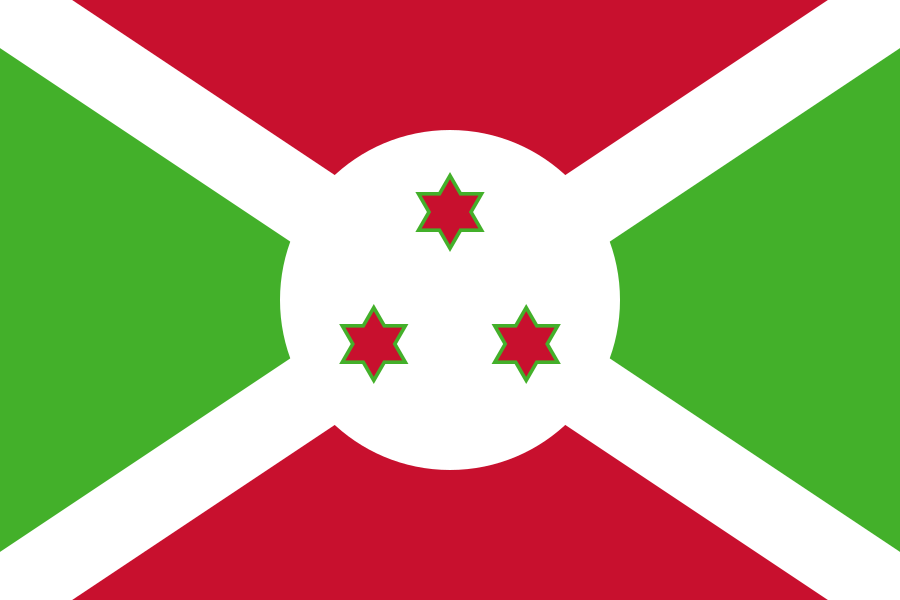
The republic replaced the monarchical symbols with three six-pointed red stars arranged in a triangle on the central disc.
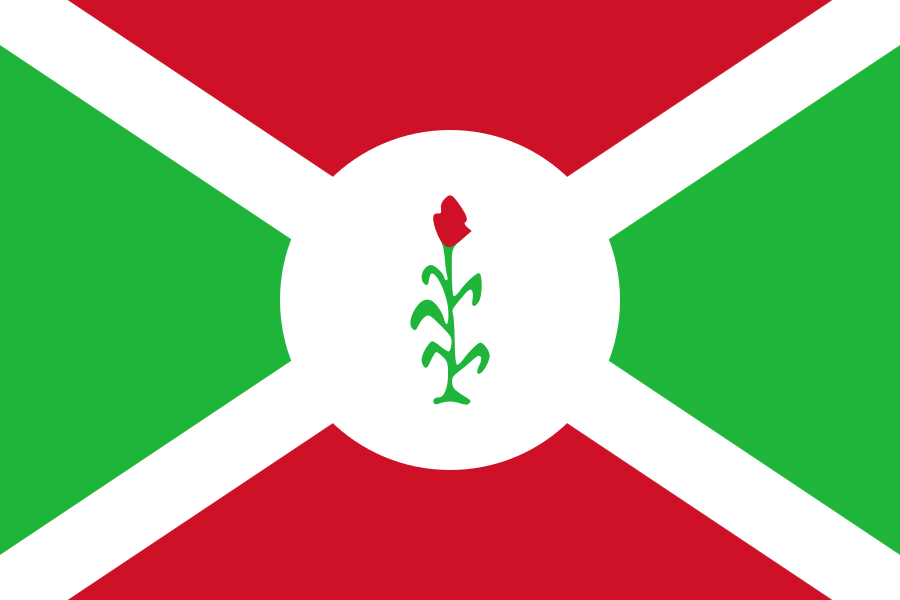
After the monarchy was abolished in 1966, the royal drum was removed, leaving the sorghum plant on the white disc — a brief transitional design.
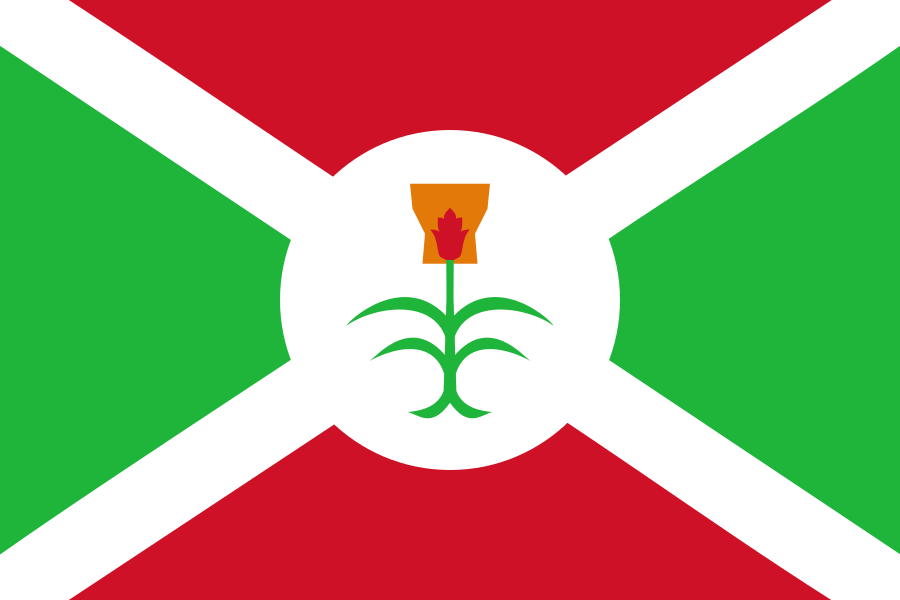
At independence as a monarchy, the flag carried a royal drum (karyenda) and a sorghum plant on the red-and-green saltire. The drum symbolized the Tutsi monarchy.
Empires, kingdoms and republics that once covered part of Burundi.
At independence Burundi was a kingdom under the mwami (king); its flag added a royal drum and a sorghum plant to the saltire design, until a 1966 coup abolished the monarchy.
Burundi shares a land border with 3 countries: the DR Congo, Rwanda and Tanzania.
12 other national flags use the same main colours as Burundi's.
Play Globalio and learn Burundi's flag DR Congo
 Rwanda
 Tanzania
 Algeria
 Belarus
 Bulgaria
 Hungary
 Iran
 Italy
 Lebanon
 Madagascar
 Maldives
 Mexico
 Oman
 Turkmenistan