Africa
Flag of Côte d'Ivoire
Côte d'Ivoire (Ivory Coast) is the world's largest producer of cocoa beans, supplying roughly a third of the global supply, and is a major economic hub in West Africa. It has two capitals: Yamoussoukro, the official political capital home to the enormous Basilica of Our Lady of Peace, and Abidjan, the economic and commercial centre. The country has a diverse cultural heritage and significant mineral resources.

- CapitalYamoussoukro
- RegionAfrica
- Current flag since1959
- Main coloursOrange, White, Green
- Populationabout 28 million
- Areaabout 322,000 km²
- Flags in history2
Population and area are rounded.
What the flag of Côte d'Ivoire means
Orange stands for the savanna of the north, white for peace and unity, and green for the forests of the south and hope for the future. The flag was adopted in 1959, a year before independence from France, and its vertical layout follows the French tricolour. It is a mirror image of Ireland's flag, though shorter in proportion.
More about the flag
Côte d'Ivoire's flag was adopted by law in December 1959, before independence from France in August 1960. The country is the world's largest producer of cocoa. Its flag is often confused with Ireland's at sporting events, since the two use the same colours in reverse order. The largest city is Abidjan, while the official capital is Yamoussoukro.
How to recognise it
Vertical orange-white-green. Ireland is the exact mirror: green-white-orange.
Did you know?
Côte d'Ivoire produces about 40% of the world's cocoa supply.
Easily confused with
Côte d'Ivoire's flag is often mixed up with these. Learn to tell them apart:
Flag history of Côte d'Ivoire
Every flag that has flown over Côte d'Ivoire, from today back through time.
1959–present
Flag of Côte d'Ivoire
Adopted in 1959 on the eve of independence: vertical orange, white and green. Orange stands for the savanna and the land's fertility, white for peace, green for the forests and hope. It is a mirror image of Ireland's flag and very close to Niger's — a similarity that is pure coincidence of pan-national colour choices.

1893–1959
French Côte d'Ivoire
Declared a French colony in 1893 and later part of French West Africa, Côte d'Ivoire flew the French tricolor. It became the wealthiest and most productive colony in the federation through cocoa and coffee, a prosperity that continued after Félix Houphouët-Boigny led it to independence in 1960 under its own orange-white-green flag.
Related historical states
Empires, kingdoms and republics that once covered part of Côte d'Ivoire.
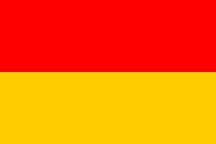
1740–present
Kingdom of Sanwi
A traditional Akan kingdom in southeastern Côte d'Ivoire that has twice attempted to secede from the modern republic.
Neighbouring countries
Côte d'Ivoire shares a land border with 5 countries: Burkina Faso, Ghana, Guinea, Liberia and Mali.
Other flags in orange, white and green
2 other national flags use the same main colours as Côte d'Ivoire's.
Play Globalio and learn Côte d'Ivoire's flag
 Ireland
 Italy
 Mexico
 Burkina Faso
 Ghana
 Guinea
 Liberia
 Mali
 Niger