Middle East
Flag of Syria
Syria is one of the oldest inhabited regions in the world, home to some of humanity's earliest permanent settlements, and Damascus is often cited as the world's oldest continuously inhabited city. The country has extraordinary historical heritage, including the ancient cities of Aleppo, Palmyra, and Bosra, all UNESCO World Heritage Sites. Syria experienced a devastating civil war beginning in 2011 that caused immense destruction to its people and to irreplaceable archaeological sites.

- CapitalDamascus
- RegionMiddle East
- Current flag since2024
- Main coloursGreen, White, Black, Red
- Populationabout 22 million
- Areaabout 185,000 km²
- Flags in history6
Population and area are rounded.
What the flag of Syria means
Syria's current flag is the independence flag, first used in 1932 under the French mandate and again from 1961 to 1963. Its green, white and black are linked to the Fatimid, Umayyad and Abbasid caliphates, and the three red stars originally stood for three regions of the country. Opposition forces adopted it during the civil war from 2011, and after the fall of Bashar al-Assad in December 2024 it replaced the red-white-black flag with two green stars used since 1980.
How to recognise it
Horizontal green-white-black with three red stars in the white stripe.
Did you know?
Syria is home to Damascus, one of the oldest continuously inhabited cities in the world.
Easily confused with
Syria's flag is often mixed up with these. Learn to tell them apart:
Flag history of Syria
Every flag that has flown over Syria, from today back through time.
2024–present
Syrian Arab Republic (current)
The green-white-black independence flag with three red stars returned as Syria's national flag after the fall of Bashar al-Assad in December 2024, and was confirmed by the constitutional declaration of March 2025. Opposition forces had flown it since the 2011 uprising as the flag of the pre-Ba'ath republic.
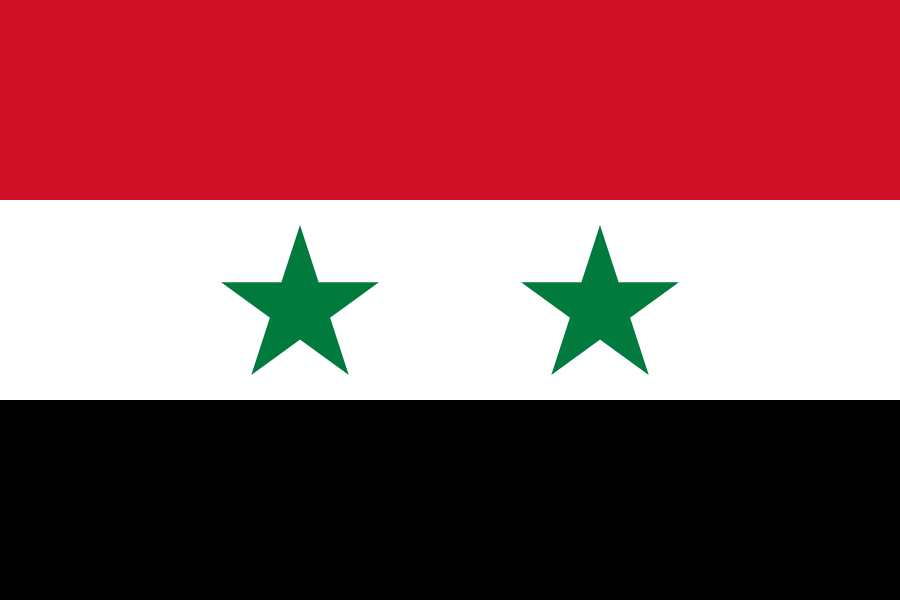
1980–2024
Ba'athist Syria (two stars)
In 1980, after the Federation of Arab Republics with Egypt and Libya ended, Syria readopted the red-white-black flag with two green stars first used by the United Arab Republic of 1958–1961, when the stars stood for Syria and Egypt. It flew under Hafez and Bashar al-Assad until the regime fell in December 2024.
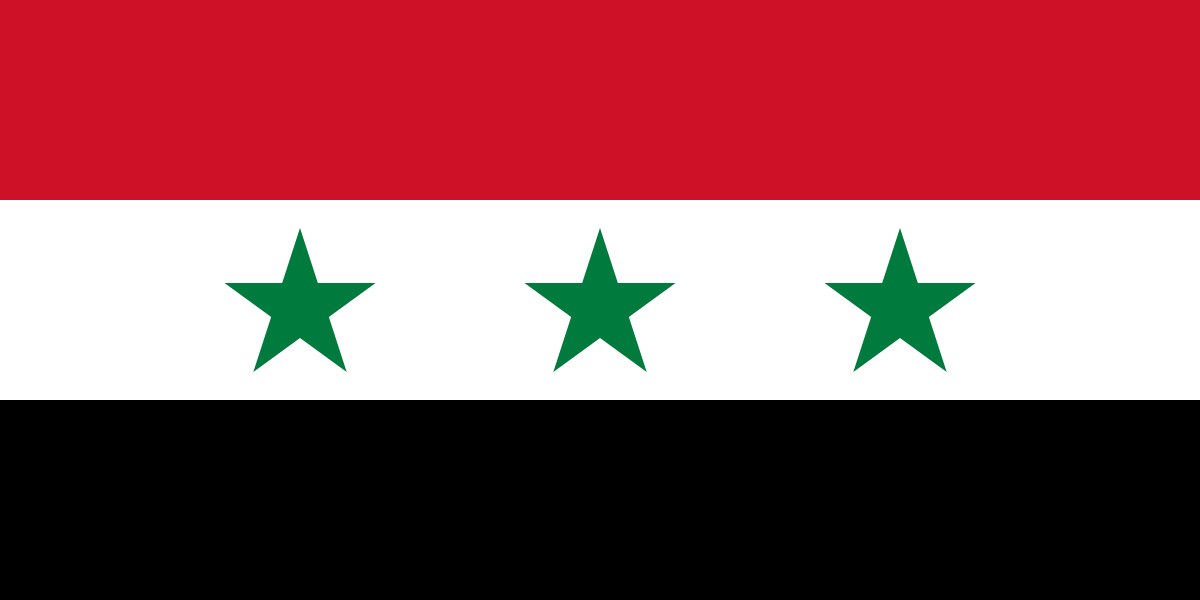
1963–1972
Ba'ath Party Syria
After the Ba'ath coup of 1963, Syria adopted a pan-Arab tricolor with three red stars representing the hoped-for union of Syria, Egypt, and Iraq. Between 1972 and 1980, Syria joined a Federation of Arab Republics with Egypt and Libya, using a flag with the Hawk of Quraish. When that federation dissolved, Syria returned to the two-star design of the United Arab Republic.
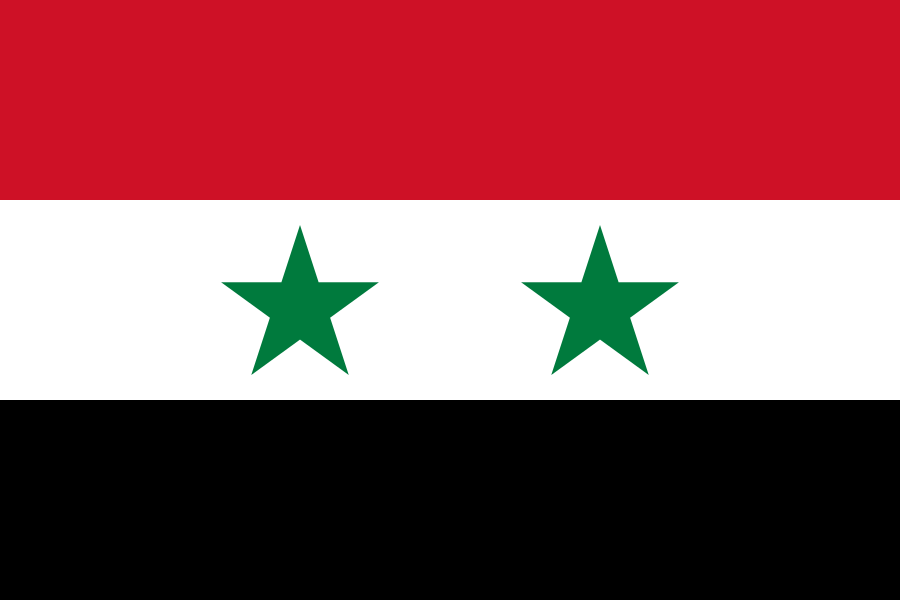
1958–1961
United Arab Republic (with Egypt)
In 1958, Syria and Egypt merged into the United Arab Republic under President Nasser — a bold experiment in pan-Arab unity. The UAR flag combined the red-white-black tricolor with two green stars for the two constituent nations and the Nasser-era eagle. Syria broke away in 1961 after a military coup, finding Egyptian dominance of the union intolerable, and the UAR essentially ceased to exist.
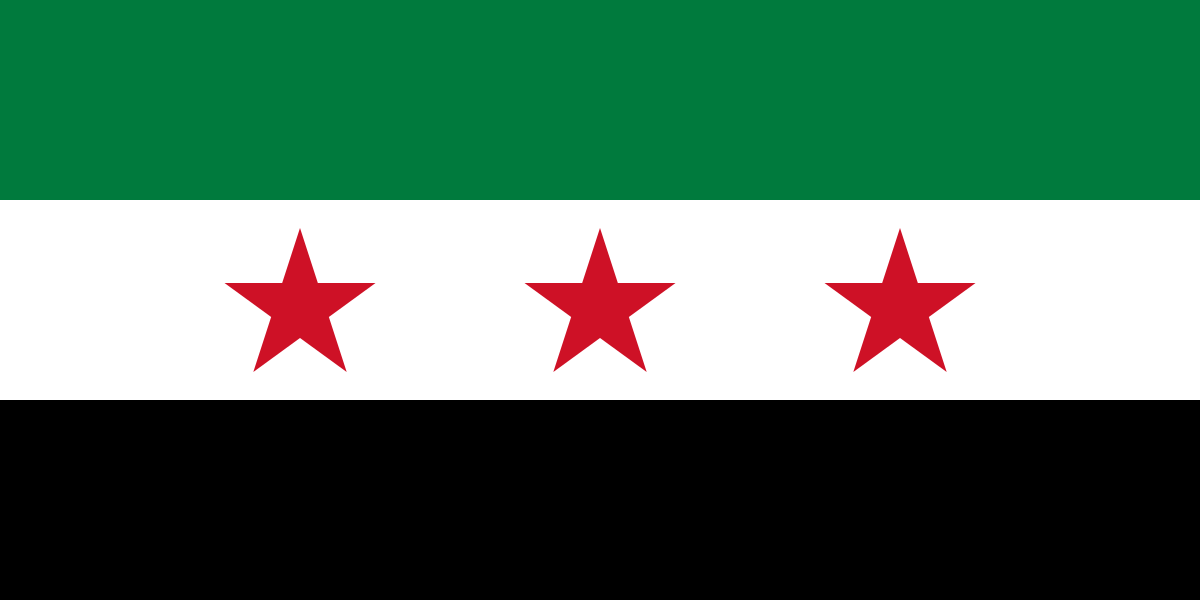
1946–1958
Syrian Republic (independence era)
When France's League of Nations mandate ended and Syria gained full independence in 1946, it flew this green-white-black tricolor with three red stars, first used under the mandate in 1932; the stars originally stood for three regions of the country. This was Syria's flag at the time of independence and remained so until the union with Egypt, and it returned from 1961 to 1963 and again in 2024.
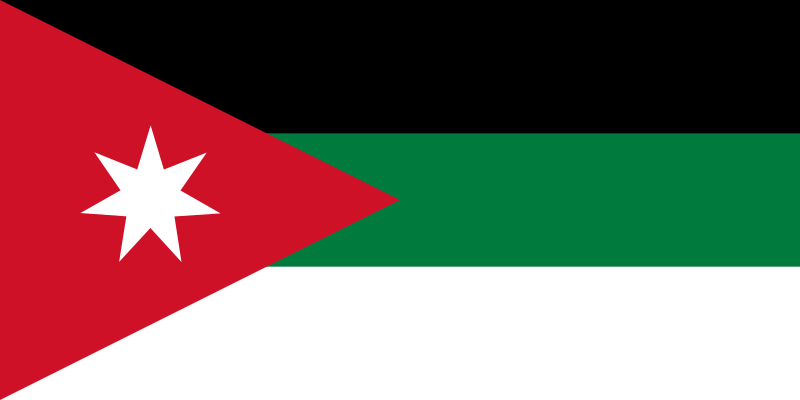
1920
Arab Kingdom of Syria
For four months in 1920, Emir Faisal — a leader of the Arab Revolt — ruled an independent Arab Kingdom of Syria from Damascus, flying the Arab Revolt flag (black-white-green bands with a red triangle and a white star). It was the first modern Arab nation-state, but France, awarded the mandate at the San Remo conference, crushed it at the Battle of Maysalun in July 1920 and began over two decades of mandate rule.
Related historical states
Empires, kingdoms and republics that once covered part of Syria.

661–750
Umayyad Caliphate
White was the Umayyad dynastic color, deliberately contrasting with the black of their Abbasid rivals. They ruled the largest empire the world had yet seen, from Damascus.
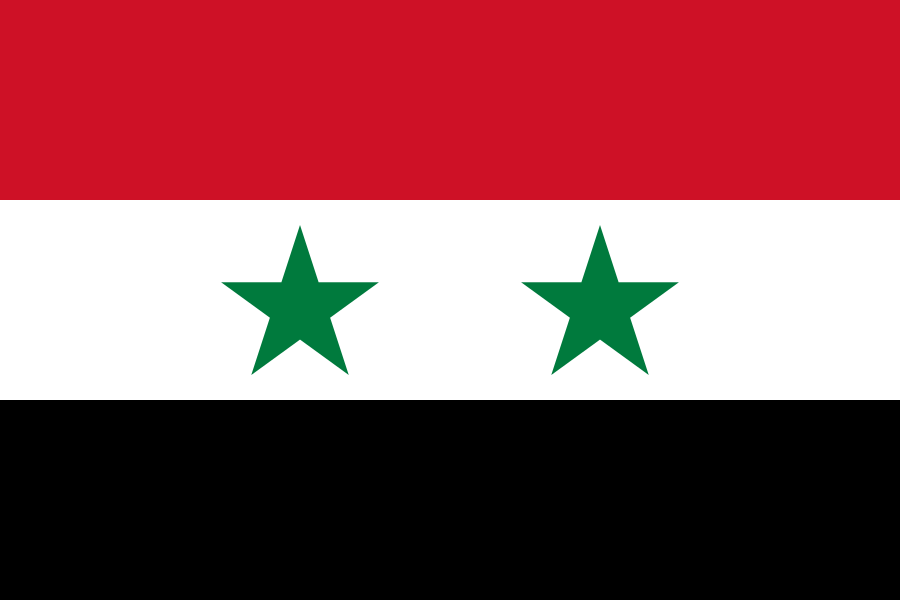
1958–1971
United Arab Republic
The two green stars stood for the two members of the brief Egypt–Syria union. Syria later readopted this exact flag, which is why it doubles as a Syrian flag.
Neighbouring countries
Syria shares a land border with 5 countries: Iraq, Israel, Jordan, Lebanon and Turkey.
Other flags in green, white, black and red
8 other national flags use the same main colours as Syria's.
Play Globalio and learn Syria's flag
 Egypt
 Iraq
 Yemen
 Israel
 Jordan
 Lebanon
 Turkey
 Afghanistan
 Kenya
 Kuwait
 Libya
 Palestine
 Sudan
 United Arab Emirates