Middle East
Flag of Kuwait
Kuwait is a small emirate in the northwestern Persian Gulf with the world's sixth-largest proven oil reserves. It was occupied by Iraq in 1990 and liberated by a US-led coalition in the 1991 Gulf War, an event that shaped modern Middle Eastern geopolitics. Kuwait has used its oil wealth to develop generous social services for its citizens, including free healthcare, education, and no personal income tax.

- CapitalKuwait City
- RegionMiddle East
- Current flag since1961
- Main coloursGreen, White, Red, Black
- Populationabout 4.3 million
- Areaabout 18,000 km²
- Flags in history2
Population and area are rounded.
What the flag of Kuwait means
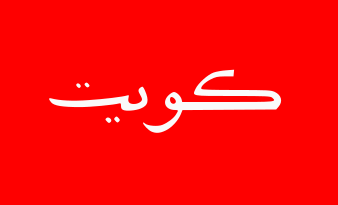
Green stands for the fertile land, white for the deeds of the people, red for the blood on Kuwaiti swords, and black for the battlefield. The colours come from a poem by Safi al-Din al-Hilli. The flag was adopted in 1961, replacing a red flag with the word Kuwait written on it.
More about the flag
Kuwait's flag was first raised on 24 November 1961, months after independence from Britain in June that year. Its proportions are 1:2. During the Iraqi occupation of 1990 to 1991 the flag became a symbol of resistance, and Kuwait celebrates National Day on 25 February and Liberation Day on 26 February.
How to recognise it
Horizontal green-white-red with a black trapezoid at the hoist.
Did you know?
Kuwait was the first Gulf state to establish a constitution and parliament, in 1962.
Easily confused with
Kuwait's flag is often mixed up with these. Learn to tell them apart:
Flag history of Kuwait
Every flag that has flown over Kuwait, from today back through time.
1961–present
State of Kuwait (independence)
Kuwait adopted its current flag on independence from Britain on June 19, 1961 — the same day independence was declared. The horizontal green-white-red stripes with a black trapezoid at the hoist are pan-Arab colours. The flag was designed to look clearly different from the simple red flags of other Gulf states. Green symbolises the fertile lands; white for peace; red for blood on enemy swords; black for the defeat of enemies — a martial reading that suits Kuwait's turbulent history, including the 1990 Iraqi invasion.
1899–1961
Kuwait under British protection
The Kuwaiti ruling family, the Al-Sabah, had invited British protection in 1899 to avoid Ottoman annexation. The pre-independence Kuwaiti flags were simple red designs — sometimes with a white serrated border similar to Bahrain's — typical of Gulf ruling families. The dramatic shift to green-white-red-black in 1961 was a deliberate assertion of Kuwaiti Arab national identity distinct from both British colonial association and the plain red Gulf tradition.
Neighbouring countries
Kuwait shares a land border with 2 countries: Iraq and Saudi Arabia.
Other flags in green, white, red and black
8 other national flags use the same main colours as Kuwait's.
Play Globalio and learn Kuwait's flag
 Jordan
 Palestine
 Iraq
 Saudi Arabia
 Afghanistan
 Kenya
 Libya
 Sudan
 Syria
 United Arab Emirates