Africa
Flag of Ghana
Ghana was the first sub-Saharan African country to gain independence from colonial rule, achieving it in 1957 under Kwame Nkrumah, inspiring independence movements across the continent. Known during the colonial era as the Gold Coast, the country chose the name Ghana after the ancient Ghana Empire. Ghana has developed into one of West Africa's most stable democracies and is a significant producer of gold, cocoa, and increasingly, oil.

- CapitalAccra
- RegionAfrica
- Current flag since1966
- Main coloursRed, Yellow, Green, Black
- Populationabout 34 million
- Areaabout 239,000 km²
- Flags in history4
Population and area are rounded.
What the flag of Ghana means
Red recalls the blood of those who fought for independence, gold the country's mineral wealth, and green its forests and farmland. The black star, a symbol of African freedom, was taken from Marcus Garvey's Black Star Line. Designed by Theodosia Okoh, the flag was adopted in 1957 when Ghana won independence from Britain.
How to recognise it
Horizontal red-gold-green with a single black star in the centre gold stripe.
Did you know?
Ghana was the first sub-Saharan African country to gain independence, in 1957.
Easily confused with
Ghana's flag is often mixed up with these. Learn to tell them apart:
Flag history of Ghana
Every flag that has flown over Ghana, from today back through time.
1966–present
Flag of Ghana (restored)
After the 1966 coup that ousted Nkrumah, the original 1957 red-gold-green flag was immediately reinstated. Designed by Theodosia Okoh, it was the first flag to use the black star, inspiring many later African flags.
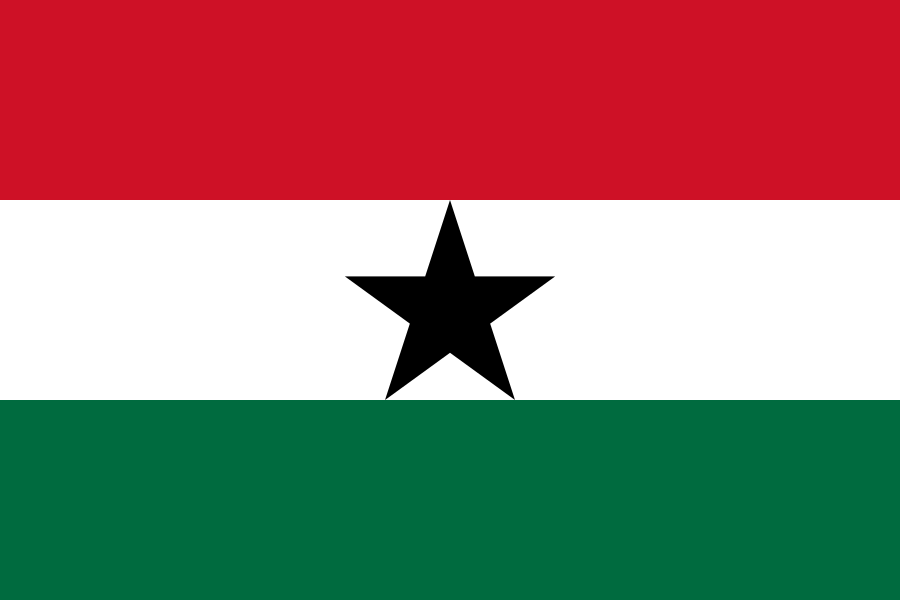
1964–1966
Nkrumah-era flag (white stripe)
After Ghana became a one-party state in 1964, the gold middle stripe was replaced with white to reflect the colors of Nkrumah's Convention People's Party. It lasted only until his 1966 overthrow.
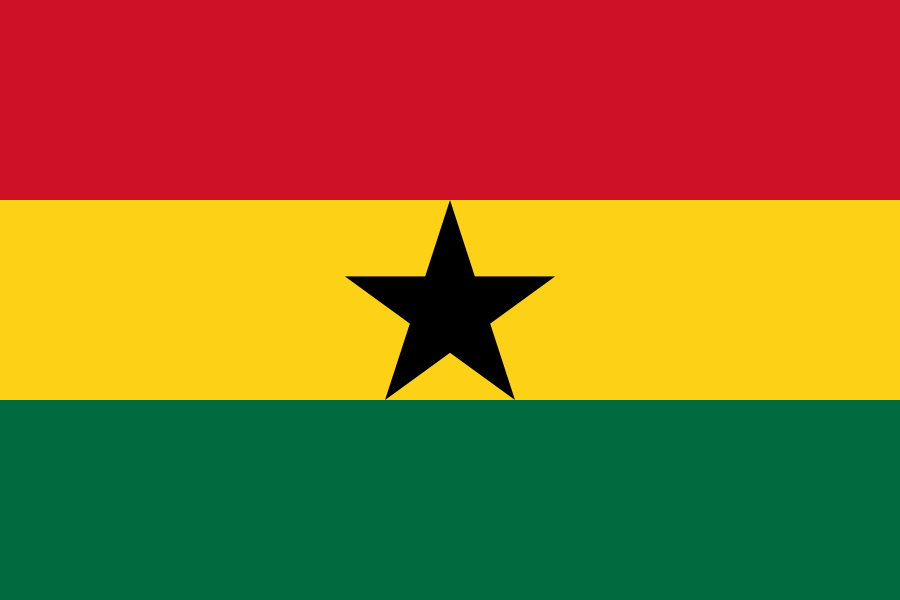
1957–1964
Independence flag
Adopted at independence in 1957 — the first national flag to use the black star and the pan-African red-gold-green, borrowed from Marcus Garvey's Black Star Line as a symbol of African emancipation.
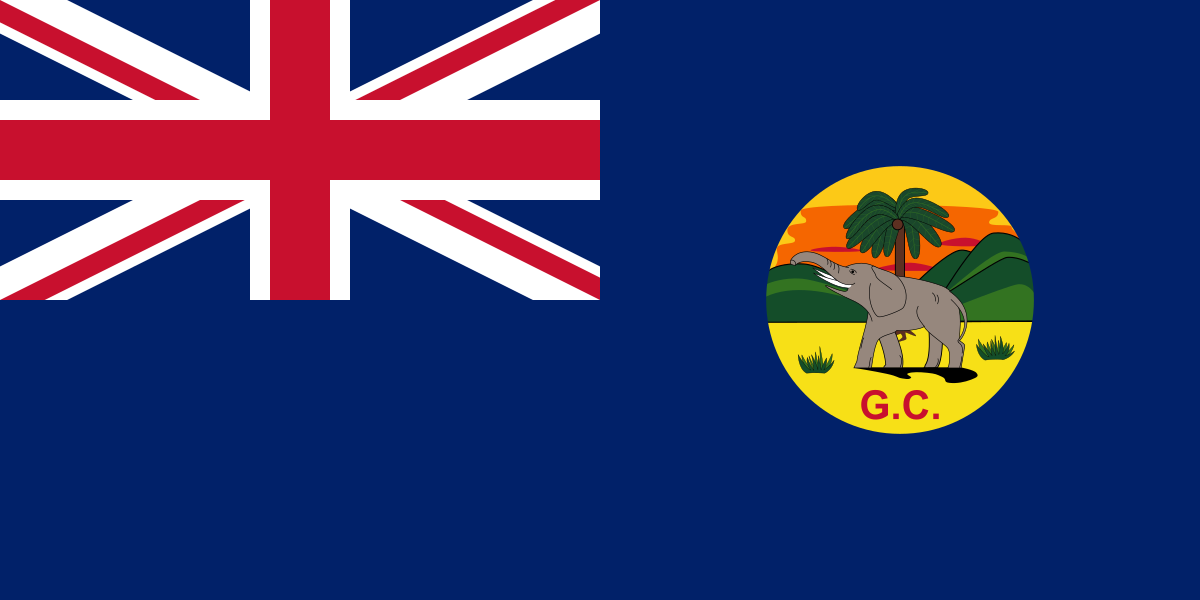
1877–1957
British Gold Coast
Britain ruled the territory as the Gold Coast — named for the gold its forts had traded alongside enslaved people for centuries — flying a Blue Ensign with an elephant-and-palm badge. To win it, Britain had to fight a series of wars against the powerful Ashanti Empire of the interior, whose Golden Stool symbolised the Asante nation. The Gold Coast became, in 1957, the first sub-Saharan African colony to win independence, as Ghana.
Related historical states
Empires, kingdoms and republics that once covered part of Ghana.
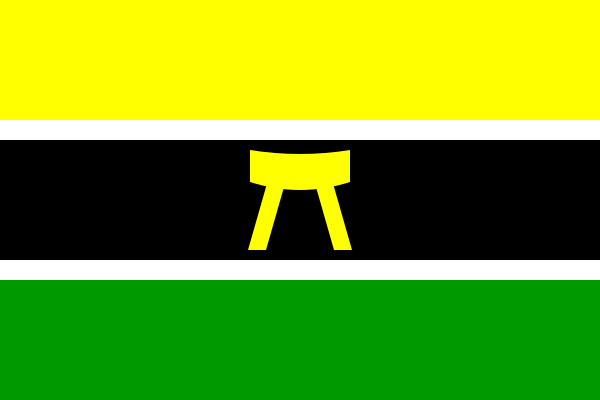
1701–1957
Ashanti Empire
The gold-black-green flag bears the Golden Stool, the sacred soul of the Asante nation. The empire favored umbrellas and the Stool over flags; this design dates to 1935.
1964–1966
Ghana (1964–1966)
Under Kwame Nkrumah's one-party state the gold stripe of the national flag was changed to white, before the 1966 coup that ousted him restored the original red-gold-green with the black star.
Neighbouring countries
Ghana shares a land border with 3 countries: Burkina Faso, Côte d'Ivoire and Togo.
Other flags in red, yellow, green and black
4 other national flags use the same main colours as Ghana's.
Play Globalio and learn Ghana's flag
 Senegal
 Ethiopia
 Cameroon
 Burkina Faso
 Côte d'Ivoire
 Togo
 Guinea-Bissau
 Malawi
 São Tomé and Príncipe
 Vanuatu