 Cameroon
 Benin

1975–present
Flag of São Tomé and Príncipe
Adopted at independence from Portugal in 1975, based on the flag of the MLSTP liberation movement. The two black stars on the yellow band represent the two islands, in pan-African colors.
São Tomé and Príncipe is a small island nation in the Gulf of Guinea and was uninhabited until Portuguese settlement in the 15th century made it one of Africa's first colonial outposts. The islands became a major sugar-producing centre using enslaved labour and were a crucial node in the Atlantic slave trade. Today São Tomé and Príncipe is known for its rich biodiversity, its peaceful transition to multiparty democracy in 1990, and the production of high-quality fine-flavour cacao.
Population and area are rounded.
Green represents the islands' lush vegetation, yellow the sun and cocoa, and red the struggle for independence. The two black stars stand for the two main islands, São Tomé and Príncipe. The flag is based on that of the independence movement MLSTP and was adopted at independence from Portugal in 1975.
São Tomé and Príncipe gained independence from Portugal on 12 July 1975. The islands lie in the Gulf of Guinea near the equator and were uninhabited when Portuguese navigators arrived in the 1470s. They became centres of sugar and later cocoa plantations worked by enslaved and then contract labourers. It is the second-smallest country in Africa by population.
Horizontal green-yellow-green with a red triangle at the hoist and two black stars in the yellow stripe.
São Tomé and Príncipe is the second-smallest African country and one of the world's largest cocoa producers relative to size.
São Tomé and Príncipe's flag is often mixed up with these. Learn to tell them apart:
Every flag that has flown over São Tomé and Príncipe, from today back through time.
Adopted at independence from Portugal in 1975, based on the flag of the MLSTP liberation movement. The two black stars on the yellow band represent the two islands, in pan-African colors.

These uninhabited equatorial islands were settled by Portugal in the late 1400s and became one of the world's first plantation economies — sugar, then coffee and cocoa — worked by enslaved Africans under the Portuguese flag. The islands flew Portugal's flag until the 1974 Carnation Revolution opened the door to independence in 1975.
The 1 states, provinces and regions of São Tomé and Príncipe with their own flags.
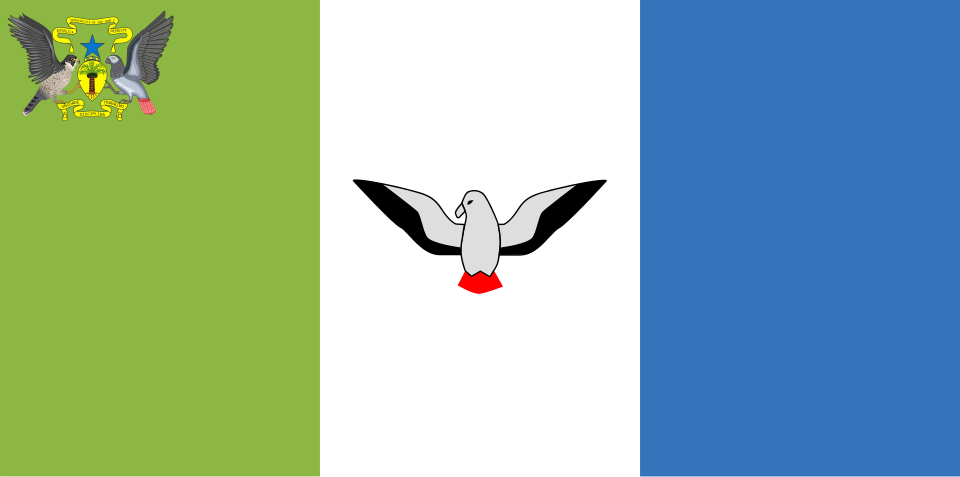 Príncipe
4 other national flags use the same main colours as São Tomé and Príncipe's.
Play Globalio and learn São Tomé and Príncipe's flag Ghana
 Guinea-Bissau
 Malawi
 Vanuatu