Asia
Flag of South Korea
South Korea occupies the southern portion of the Korean Peninsula and has achieved one of the most dramatic economic transformations in history, going from one of the world's poorest nations after the 1950-53 Korean War to a high-income, technologically advanced society in a single generation. It is home to globally recognised companies including Samsung, LG, Hyundai, and Kia. South Korean pop culture — K-pop, K-drama, and films such as the Oscar-winning Parasite — has achieved extraordinary global reach.

- CapitalSeoul
- RegionAsia
- Current flag since1984
- Main coloursWhite, Red, Blue, Black
- Populationabout 52 million
- Areaabout 100,000 km²
- Flags in history7
Population and area are rounded.
What the flag of South Korea means
The Taegukgi's white background stands for purity and peace, the red and blue taegeuk at the centre for the balance of opposing forces in the universe, and the four black trigrams from the I Ching for heaven, earth, fire and water. The design dates from the 1880s and was standardised by the Republic of Korea in 1949.
How to recognise it
White with a red-blue yin-yang (Taeguk) circle and four black trigrams in the corners.
Did you know?
South Korea has the world's fastest average internet speed and highest smartphone ownership rate.
Easily confused with
South Korea's flag is often mixed up with these. Learn to tell them apart:
Flag history of South Korea
Every flag that has flown over South Korea, from today back through time.
1984–present
Taegukgi (standardised)
Korea's Taegukgi — white field, red-and-blue yin-yang (taegeuk) at centre, four black trigrams at corners — was formally standardised in 1984, fixing proportions and exact trigram arrangement. The design has been a Korean national symbol since its first use in 1882 and remained unchanged in concept through the Japanese occupation and the establishment of the Republic of Korea in 1948.
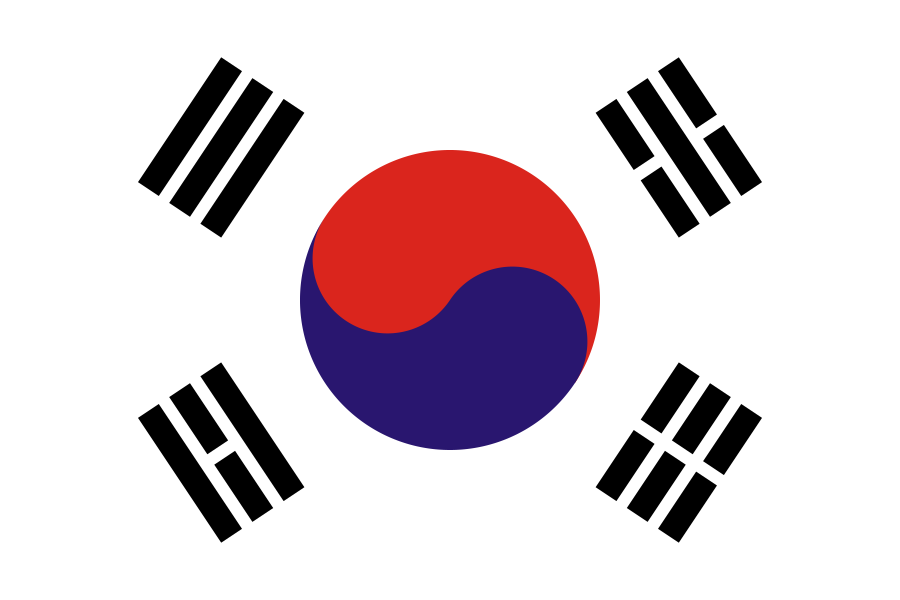
1949–1984
Taegukgi (1949 specification)
When the Republic of Korea was proclaimed in 1948, the trigrams were initially placed in a slightly different orientation. The 1949 official specification corrected this, but minor inconsistencies in which trigrams appeared in which corners persisted in practice until the 1984 standardisation finally resolved the ambiguity.

1910–1945
Japanese occupation
From 1910 to 1945 Korea was a colony of Imperial Japan, which flew its own flag and banned the Taegukgi, forcing Korean assimilation — Japanese names, Japanese language in schools, the suppression of Korean culture. The Taegukgi survived as the banner of the independence movement and the Korean Provisional Government in exile, raised again at liberation in 1945.
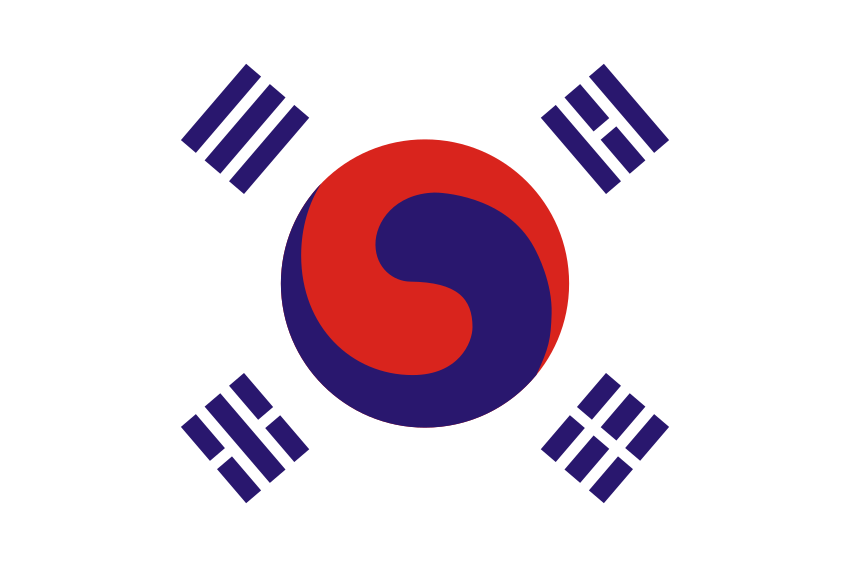
1897–1910
Korean Empire (Taegeukgi)
When King Gojong declared the Korean Empire in 1897 to assert sovereignty against both China and Japan, the Taegeukgi continued as the national symbol. In 1910 Japan annexed Korea and suppressed the flag entirely. For 35 years under Japanese colonial rule, displaying this flag was an act of resistance — and it became a powerful symbol of the independence movement.
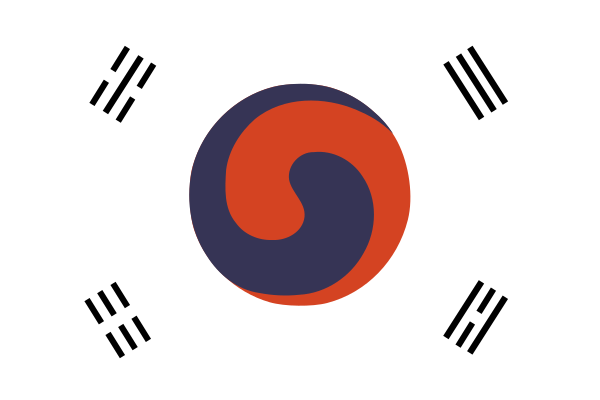
1882–1897
First Taegukgi (Joseon dynasty)
Korea's first national flag was created in 1882 by diplomat Pak Yeong-hyo during a diplomatic mission to Japan, based on instructions from King Gojong. The taegeuk (yin-yang) symbol and trigrams draw on Confucian cosmology. This first version had eight trigrams; later versions reduced them to four.
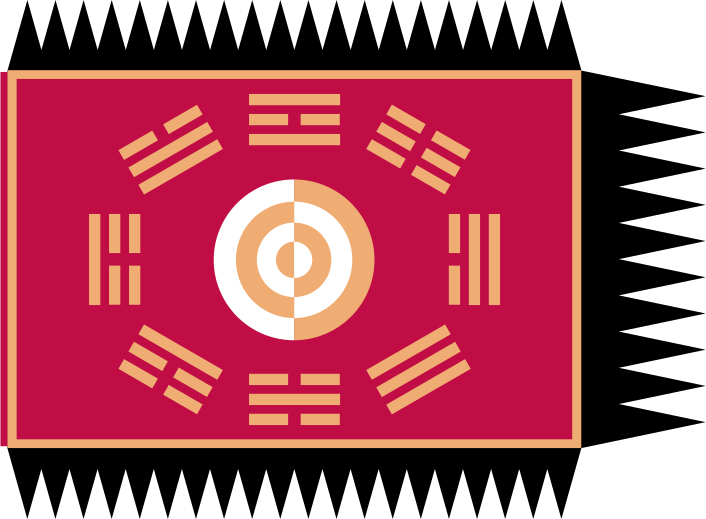
1392–1882
Royal standard of Joseon
Korea had no "national flag" in the modern sense before 1882 — but the kings of the Joseon dynasty (1392–1897), Korea's last and longest royal house, flew a royal standard bearing the taegeuk and trigrams. That same Confucian cosmology was carried directly into the 1882 Taegukgi, making the royal banner the conceptual ancestor of every Korean flag.
1961–1963
Supreme Council for National Reconstruction
The military junta that ruled South Korea after Park Chung-hee's 1961 coup, before his civilian-styled presidency.
Related historical states
Empires, kingdoms and republics that once covered part of South Korea.
1897–1910
Korean Empire
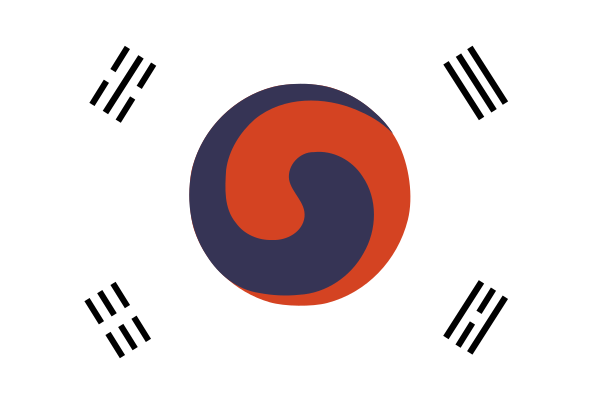
The Taegukgi — white field with a blue-red taegeuk and four black trigrams — was adopted in 1883 and flew over the Joseon kingdom and the Korean Empire until Japan annexed Korea in 1910.
918–1392
Goryeo Dynasty
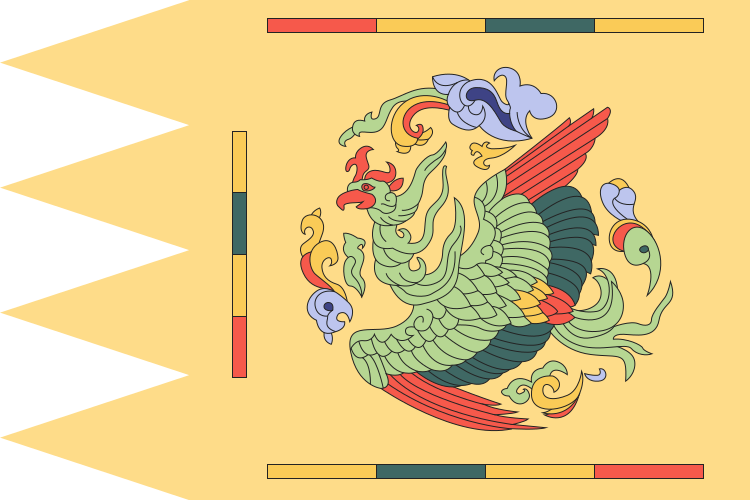
The medieval Korean dynasty that gave the country its English name. This reconstructed royal phoenix banner stands in for an era that used no national flag.
1919–1948
Provisional Government of Korea
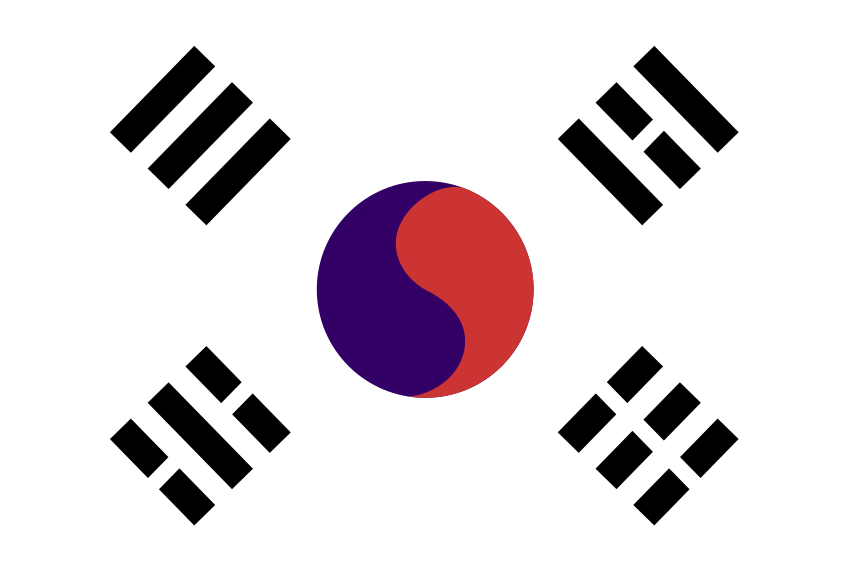
Exiled in Shanghai after Japan's annexation, Korea's provisional government flew an early Taegukgi as it lobbied for independence; its legacy is claimed by the modern Republic of Korea.
Regional flags of South Korea
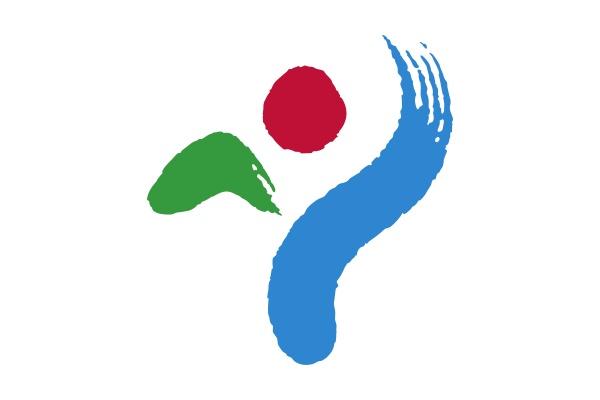
The 17 states, provinces and regions of South Korea with their own flags.
Seoul
Busan
Daegu

Incheon

Gwangju
Daejeon
Ulsan

Sejong
Gyeonggi

Gangwon

North Chungcheong
South Chungcheong

North Jeolla

South Jeolla

North Gyeongsang

South Gyeongsang

Jeju
Neighbouring countries
South Korea shares a land border with one country: North Korea.
Play Globalio and learn South Korea's flag
 North Korea